The question: why is life single-handed?
Many molecules exist in two forms that are mirror images of each other, like a left and a right hand. These enantiomers contain exactly the same atoms joined in the same order, yet they cannot be superimposed. In an ordinary laboratory reaction that starts from non-chiral materials, the two hands are formed in equal amounts, as a racemic mixture.
Living things are different. Proteins are built from L-amino acids, while DNA and RNA are built on D-sugars, and the right-handed double helix of DNA follows from that choice. Enzymes, receptors and drug targets are therefore chiral, and the two enantiomers of a drug can behave differently in the body. How a single hand came to dominate biology, and how chemists can make one hand selectively, are two sides of the same puzzle.
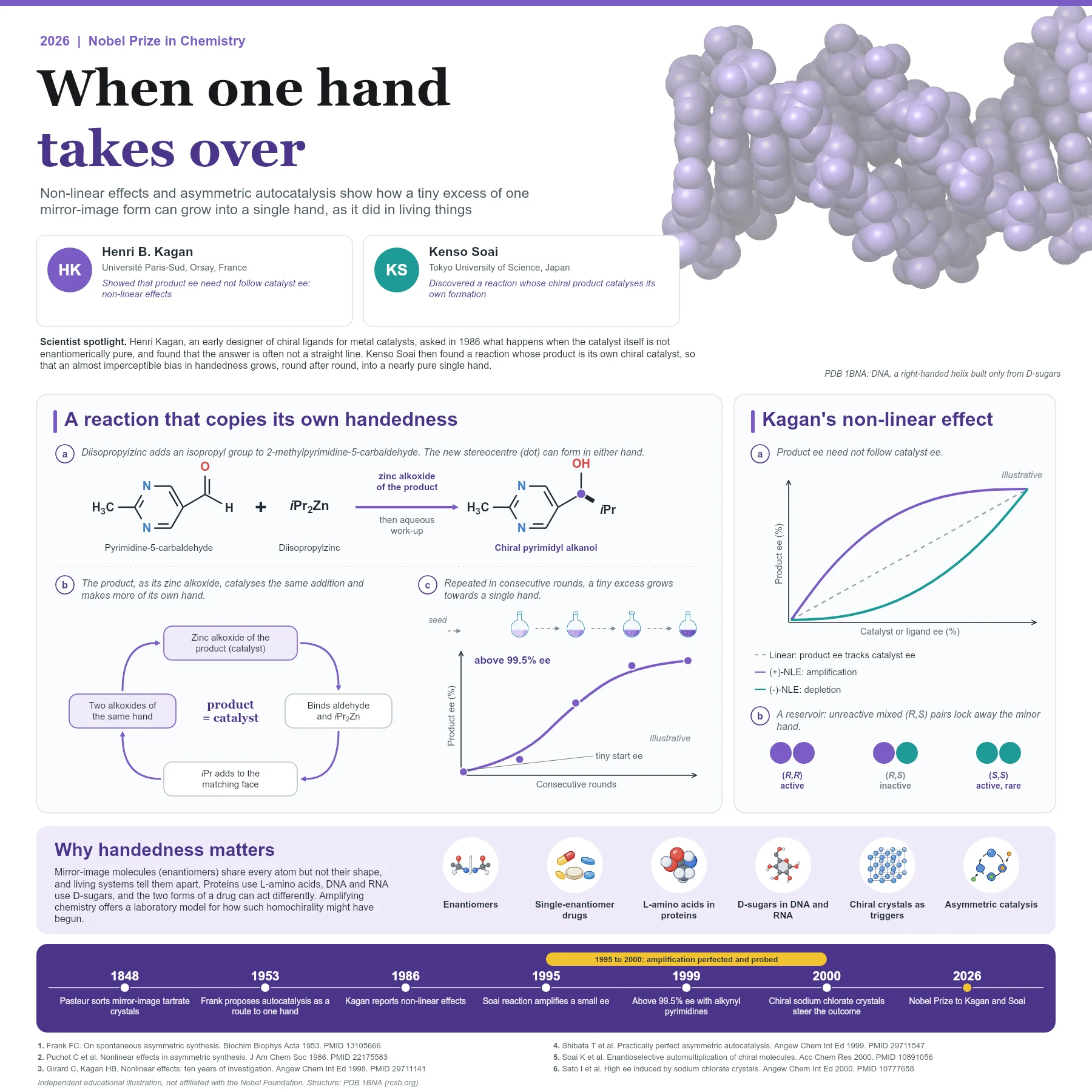
The 2026 Nobel Prize in Chemistry recognised Henri B. Kagan and Kenso Soai for showing how chirality can be amplified in chemical reactions: through non-linear effects in asymmetric catalysis, and through asymmetric autocatalysis, in which a chiral product catalyses its own formation.
Kagan's surprise: when catalyst purity does not add up
Asymmetric catalysis uses a small amount of a chiral catalyst, often a metal bound to a chiral ligand, to make one enantiomer of a product in excess. The enantiomeric excess (ee) measures how far a mixture is from racemic: the difference between the major and minor enantiomer divided by their sum. It was long assumed that if the catalyst or its ligand was only partly pure, the ee of the product would fall in proportion.
In 1986 Kagan and his colleagues in Orsay reported that this is not always so. In asymmetric oxidations and aldol reactions, the product ee plotted against the ee of the chiral auxiliary was not a straight line. Sometimes the curve bowed upwards, so that a modestly pure catalyst gave a surprisingly pure product, a positive non-linear effect or asymmetric amplification. Sometimes it bowed downwards, a negative non-linear effect.
The explanation lies in how catalyst molecules associate. If catalyst units pair up, the mixed pairs that contain one left-handed and one right-handed unit can be more stable and less active than the pairs of the same hand. The minor enantiomer is then locked away in an unreactive reservoir, and the remaining active catalyst is effectively purer than the bulk. Kagan and Girard summarised a decade of such studies in 1998.
Soai's reaction: a product that makes more of itself
Kenso Soai at the Tokyo University of Science studied the addition of diisopropylzinc to pyrimidine-5-carbaldehydes. The reaction creates a new stereocentre and, after work-up, a chiral pyrimidyl alkanol. In 1995 his group reported that this product, as its zinc alkoxide, acts as a catalyst for its own formation and favours its own handedness. Starting with a slight excess of one enantiomer, each round of reaction produced more of the same hand, and the ee rose.
When the products of one round were used to seed the next, a tiny initial imbalance grew round after round. With 2-alkynyl pyrimidine aldehydes, the group reported in 1999 practically perfect asymmetric autocatalysis, in which the product was obtained in above 99.5% ee. A 2000 review in Accounts of Chemical Research described how autocatalysts with extremely low ee multiply with significant amplification, without any other chiral additive.
Kagan's non-linear effects and Soai's autocatalysis connect: in both, aggregates of catalyst molecules can sideline the minority hand, and a small advantage becomes a large one.
From a model reaction to the origin of homochirality
In 1953 the physicist F. C. Frank proposed, on paper, that a chemical system in which each enantiomer catalyses its own formation and suppresses the other could turn a random imbalance into a single hand. Soai's reaction gave chemists a real example that behaves in this way.
Because the reaction can amplify an almost undetectable bias, it also became a tool for asking which physical influences can tip the balance in the first place. Soai's group showed, for example, that chiral crystals of sodium chlorate could steer the reaction to a product of high ee (2000), and later work used helical hydrocarbons and circularly polarised light as the initial trigger. None of this proves how homochirality arose on the early Earth, but it shows that a plausible chemical mechanism exists.
Why it matters today
Non-linear effects are now part of the toolkit for understanding and designing asymmetric catalysts. They help chemists work out how many catalyst molecules take part in the key step, and they explain why some catalysts give highly enantioenriched products even from partly resolved ligands. Single-enantiomer drugs and agrochemicals depend on such catalysts.
Asymmetric autocatalysis remains one of the clearest chemical demonstrations of how order can emerge from near-symmetry, and it keeps informing research on the chemistry that preceded life. The prize honours two careers that turned a question as simple as left versus right into a deep lesson about amplification in chemistry.
Key takeaways
- Enantiomers are mirror-image molecules; life uses L-amino acids and D-sugars.
- Kagan showed in 1986 that product ee need not be proportional to catalyst ee: positive and negative non-linear effects.
- Unreactive mixed-hand catalyst pairs can lock away the minor enantiomer and amplify selectivity.
- In the Soai reaction the chiral pyrimidyl alkanol catalyses its own formation, amplifying a tiny ee to above 99.5% ee.
- The reaction is a working chemical model for how a single hand could take over.
References
- Frank FC. On spontaneous asymmetric synthesis. Biochim Biophys Acta. 1953;11:459-463. PubMed 13105666
- Puchot C, Samuel O, Dunach E, et al. Nonlinear effects in asymmetric synthesis. Examples in asymmetric oxidations and aldolization reactions. J Am Chem Soc. 1986;108(9):2353-2357. PubMed 22175583
- Girard C, Kagan HB. Nonlinear effects in asymmetric synthesis and stereoselective reactions: ten years of investigation. Angew Chem Int Ed Engl. 1998;37(21):2922-2959. PubMed 29711141
- Shibata T, Yonekubo S, Soai K. Practically perfect asymmetric autocatalysis with (2-alkynyl-5-pyrimidyl)alkanols. Angew Chem Int Ed Engl. 1999;38:659-661. PubMed 29711547
- Soai K, Shibata T, Sato I. Enantioselective automultiplication of chiral molecules by asymmetric autocatalysis. Acc Chem Res. 2000;33(6):382-390. PubMed 10891056
- Sato I, Kadowaki K, Soai K. Asymmetric synthesis of an organic compound with high enantiomeric excess induced by inorganic ionic sodium chlorate. Angew Chem Int Ed Engl. 2000;39:1510-1512. PubMed 10777658
- Soai K, Kawasaki T. Discovery of asymmetric autocatalysis with amplification of chirality and its implication in chiral homogeneity of biomolecules. Chirality. 2006;18(7):469-478. PubMed 16676331
An independent educational article and illustration by BioGein, not affiliated with or endorsed by the Nobel Foundation. Protein structures are rendered from Protein Data Bank entries (rcsb.org).