The question: can a crystal be designed like a building?
Most crystals are dense. Their atoms pack together as tightly as their bonds allow, which is why table salt or quartz has no useful space inside. Chemists have long wanted the opposite: a solid that is mostly empty, with pores of a chosen size that molecules can enter and leave. Natural minerals such as zeolites offer some of this, but their pores are hard to redesign.
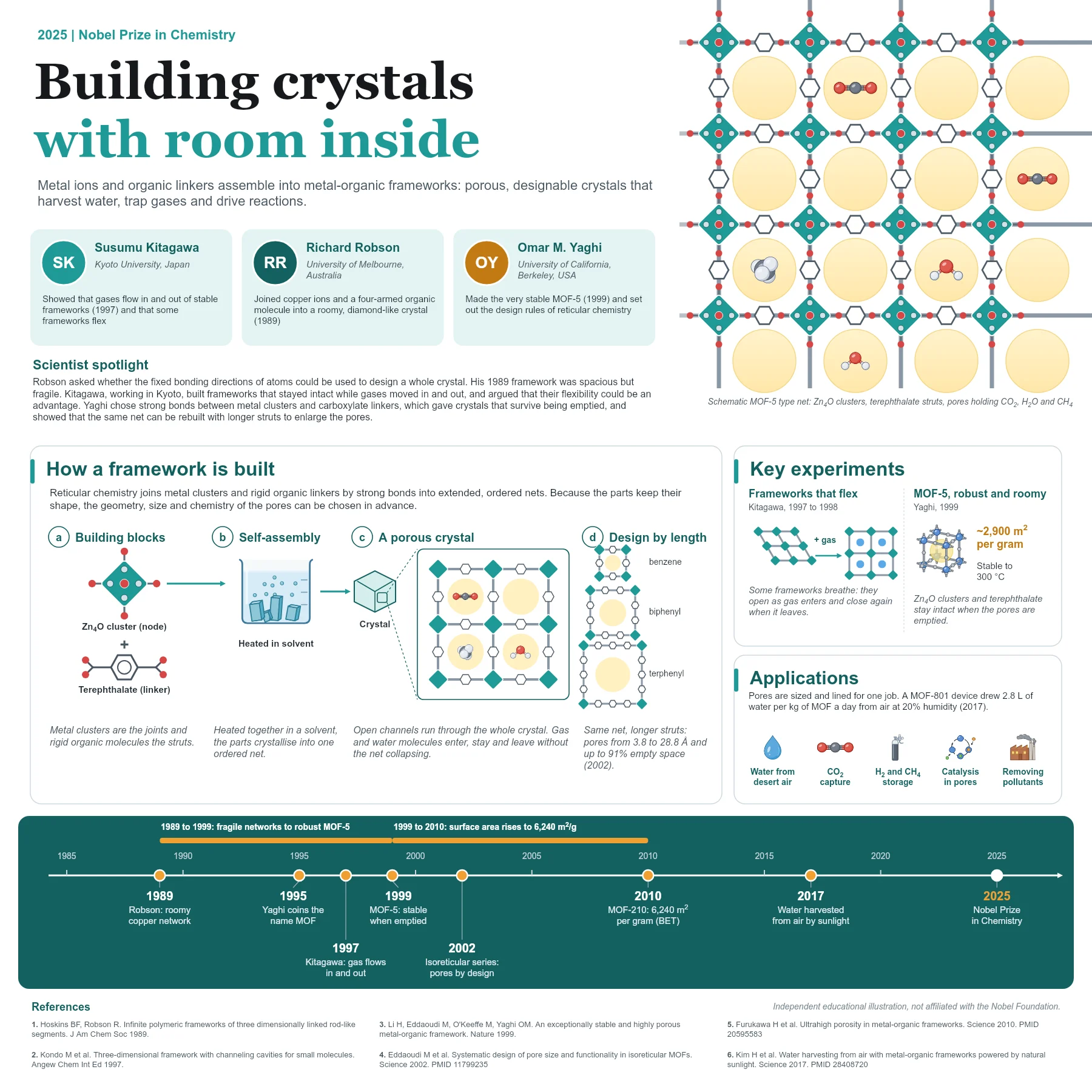
The 2025 Nobel Prize in Chemistry went to Susumu Kitagawa, Richard Robson and Omar M. Yaghi for developing metal-organic frameworks, usually shortened to MOFs. These are crystals assembled from two kinds of parts: metal ions or small metal clusters that act as joints, and rigid organic molecules that act as struts. Choose the joints and the struts, and you choose the geometry of the whole crystal and the size of its holes.
The discovery story
Robson asked whether the fixed bonding directions of atoms could be used to plan an entire crystal. In 1989 he and Bernard Hoskins combined copper ions with a four-armed organic molecule and obtained a spacious, diamond-like network with large cavities. It was a striking proof of principle, but the framework was fragile.
Kitagawa, working in Kyoto, built frameworks from metal ions and organic linkers that stayed intact while gases flowed in and out. In 1997 his group reported a three-dimensional framework with channels that could take up and release small gas molecules. He also argued that some frameworks should be flexible, opening and closing as guests arrive and leave, and that this softness could be an advantage rather than a flaw.
Yaghi chose strong bonds between metal clusters and carboxylate linkers. In 1999 his group described MOF-5, built from zinc oxide clusters (Zn4O) and terephthalate, the same linker found in many plastics. MOF-5 kept its structure when its pores were emptied and stayed stable up to about 300 °C, with a very large internal surface. In 2002 the group showed that the same net could be rebuilt with longer struts or decorated with different chemical groups, giving a family of sixteen related crystals with pores from 3.8 to 28.8 ångström and up to 91% open space. Yaghi called this approach reticular chemistry: designing nets from building blocks.
How a framework works
A MOF forms when metal salts and organic linkers are heated together in a solvent. The metal ions gather into small clusters, each carrying several carboxylate groups that point in fixed directions. Linkers bridge neighbouring clusters, and because both parts are rigid, the growing solid has only one sensible way to arrange itself: an ordered, repeating net.
The space between the struts forms connected channels that run through the whole crystal. Once the solvent is removed, gas or water molecules can diffuse in, stick to the walls and later leave again. The internal surface is enormous: in 2010 Yaghi's group reported MOF-210 with a measured surface area of 6,240 square metres per gram.
Design follows from the parts. Longer linkers give larger pores; a linker carrying an amino group or a bromine atom changes how the pore walls attract guests; a different metal changes the geometry of the joints. Kitagawa's flexible frameworks add a further trick: some crystals stay closed until gas reaches a threshold pressure, then open suddenly, which can be used to separate gases.
From discovery to applications
Tens of thousands of MOFs have now been made. One widely reported example is water harvesting. In 2017 a team including Yaghi and Evelyn Wang built a device around the zirconium framework MOF-801 that captured water vapour from air at night and released it in sunlight, yielding 2.8 litres of water per kilogram of MOF per day at relative humidity as low as 20%.
Other uses under study or in early deployment include capturing carbon dioxide from flue gas, storing hydrogen and methane at lower pressure, separating gases, carrying catalysts inside the pores, and removing pollutants such as persistent fluorinated chemicals from water. Each application relies on the same principle: pores sized and lined for one job.
Why it matters today
MOFs changed how chemists think about solids. Instead of discovering a porous material and hoping it is useful, they can now sketch the pore they want and select parts to build it. That design logic links the 1989 diamond-like network, Kitagawa's breathing frameworks and Yaghi's stable, expandable MOF-5, and it is why the field matters for water, energy and the climate.
Key takeaways
- Metal-organic frameworks are crystals of metal clusters joined by rigid organic linkers, with designed pores.
- Robson showed the idea in 1989, Kitagawa made stable and flexible frameworks for gases, Yaghi built MOF-5 and the rules of reticular chemistry.
- Changing linker length or side groups tunes pore size and chemistry without changing the net.
- Applications include water harvesting from dry air, carbon capture, gas storage, catalysis and pollutant removal.
References
- Hoskins BF, Robson R. Infinite polymeric frameworks consisting of three dimensionally linked rod-like segments. J Am Chem Soc. 1989;111:5962-5964. DOI
- Kondo M, Yoshitomi T, Seki K, Matsuzaka H, Kitagawa S. Three-dimensional framework with channeling cavities for small molecules. Angew Chem Int Ed Engl. 1997;36:1725-1727. DOI
- Li H, Eddaoudi M, O'Keeffe M, Yaghi OM. Design and synthesis of an exceptionally stable and highly porous metal-organic framework. Nature. 1999;402:276-279. DOI
- Eddaoudi M, Kim J, Rosi N, Vodak D, Wachter J, O'Keeffe M, Yaghi OM. Systematic design of pore size and functionality in isoreticular MOFs and their application in methane storage. Science. 2002;295(5554):469-472. PubMed 11799235
- Yaghi OM, O'Keeffe M, Ockwig NW, Chae HK, Eddaoudi M, Kim J. Reticular synthesis and the design of new materials. Nature. 2003;423(6941):705-714. PubMed 12802325
- Furukawa H, Ko N, Go YB, et al. Ultrahigh porosity in metal-organic frameworks. Science. 2010;329(5990):424-428. PubMed 20595583
- Kim H, Yang S, Rao SR, et al. Water harvesting from air with metal-organic frameworks powered by natural sunlight. Science. 2017;356(6336):430-434. PubMed 28408720
An independent educational article and illustration by BioGein, not affiliated with or endorsed by the Nobel Foundation. Protein structures are rendered from Protein Data Bank entries (rcsb.org).