The question: why does the immune system not attack the body?
T cells recognise antigens through receptors assembled by random gene rearrangement. That randomness lets the immune system respond to almost any microbe, but it also produces receptors that recognise the body's own proteins. In the thymus, most strongly self-reactive T cells are deleted, a process called central tolerance. Yet the filter is imperfect, and self-reactive T cells can be found in the blood of healthy people.
Something else must keep these cells quiet in the tissues. For a time in the 1970s, immunologists spoke of suppressor T cells, but the idea lost credibility in the 1980s because nobody could pin the cells down with reliable markers or molecular mechanisms. The 2025 prize rewards the work that brought suppression back on firm ground.
The discovery story: from thymectomy to CD25 to FOXP3
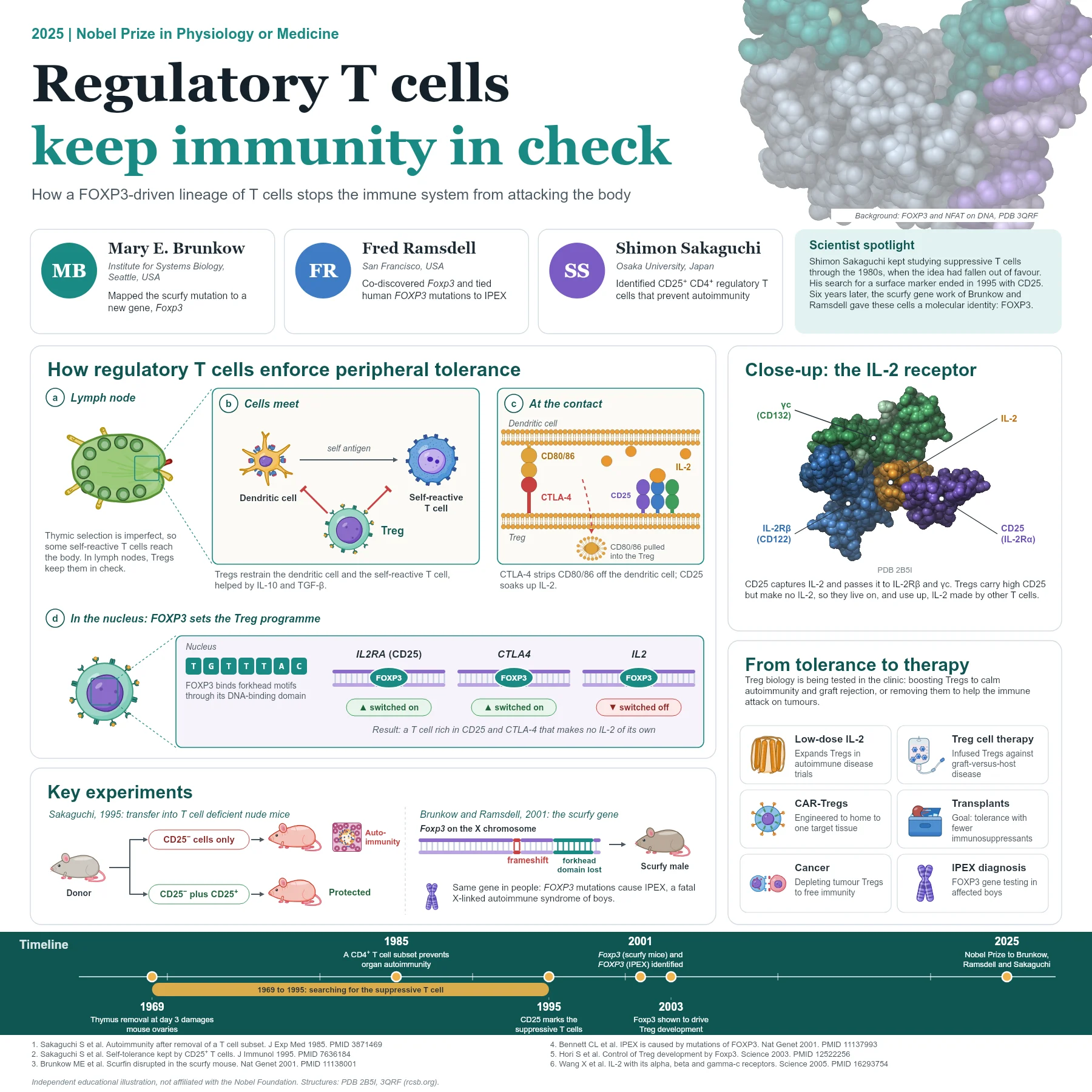
A first clue came in 1969, when Nishizuka and Sakakura found that removing the thymus from mice on the third day of life damaged the ovaries, whereas later removal did not. Shimon Sakaguchi pursued this puzzle. In 1985 he showed that transferring T cells depleted of a particular subset into athymic nude mice caused autoimmune disease in organs such as the stomach, thyroid and ovary, and that adding back the missing CD4+ cells prevented it.
In 1995 Sakaguchi identified the marker that made these cells tractable: CD25, the alpha chain of the receptor for interleukin-2. About one in ten CD4+ T cells in mice carried it. When CD25+ cells were removed before transfer, nude mice developed thyroiditis, gastritis, insulitis and other autoimmune diseases; returning CD4+ CD25+ cells prevented this in a dose-dependent way.
Meanwhile Mary Brunkow and Fred Ramsdell were hunting the gene behind scurfy, an X-linked mouse mutant in which males die within weeks from an uncontrolled expansion of CD4+ T cells. In 2001 they identified a new forkhead transcription factor gene, Foxp3, carrying a frameshift that removes the forkhead DNA-binding domain. In the same year, with clinical colleagues, they showed that mutations in human FOXP3 cause IPEX, a severe X-linked autoimmune syndrome of boys. In 2003, Sakaguchi's group and others showed that Foxp3 is expressed in CD4+ CD25+ regulatory T cells and that introducing Foxp3 into naive T cells pushes them towards a regulatory phenotype.
How regulatory T cells work
Regulatory T cells, or Tregs, sit in lymph nodes and tissues alongside dendritic cells and conventional T cells. They act on both. Their CTLA-4 binds the costimulatory molecules CD80 and CD86 on dendritic cells more tightly than the activating receptor CD28 does, and can strip these molecules from the cell surface, so other T cells receive a weaker go signal.
Tregs also act as an interleukin-2 sink. They carry high levels of CD25, which captures IL-2 and passes it to the beta and common gamma chains of the receptor. The crystal structure of this four-part complex, solved in 2005, shows how CD25 grabs the cytokine first. Because FOXP3 represses the IL2 gene, Tregs cannot make IL-2 themselves; they depend on, and use up, IL-2 made by activated conventional T cells. Tregs also release inhibitory cytokines such as IL-10 and TGF-beta.
Inside the nucleus, FOXP3 binds DNA through its forkhead domain and sets a gene programme: CD25 and CTLA-4 up, IL-2 down. When FOXP3 is lost, as in scurfy mice and IPEX, the whole suppressive lineage fails and autoimmunity follows.
From discovery to applications
Knowing that tolerance has a dedicated cell type opened two therapeutic directions. One is to boost Tregs: low doses of IL-2, which favour cells with high CD25, and infusions of expanded Tregs are being tested in autoimmune disease, type 1 diabetes, graft-versus-host disease and organ transplantation. Engineered CAR-Tregs aim to bring suppression to a single target tissue.
The other direction is to remove Tregs where they protect tumours from immune attack. Many tumours are rich in Tregs, and strategies to deplete or inactivate them are under clinical study. For families affected by IPEX, FOXP3 testing provides a diagnosis, and haematopoietic stem cell transplantation can be curative.
Why it matters today
The idea that the immune system contains its own brakes has reshaped immunology. Autoimmunity, allergy, transplant rejection and cancer can all be seen partly as problems of balance between effector and regulatory cells. The story also shows how a mouse mutant, a careful transfer experiment and a rare human disease converged on the same answer, a lesson in how basic research and clinical genetics reinforce each other.
Many questions remain open. Researchers are still mapping how Tregs adapt to different tissues, how they recognise antigen, how stable FOXP3 expression is during inflammation and how to expand or engineer them safely in patients. The answers will decide whether harnessing the body's own peacekeepers can become routine medicine.
Key takeaways
- Central tolerance in the thymus is incomplete; regulatory T cells enforce peripheral tolerance.
- Sakaguchi identified CD25 as the marker of suppressive CD4+ T cells in 1995.
- Brunkow and Ramsdell traced the scurfy mouse and human IPEX syndrome to mutations in Foxp3/FOXP3 in 2001.
- Tregs suppress through CTLA-4, IL-2 consumption via CD25 and inhibitory cytokines.
- Treg-based therapies for autoimmunity, transplantation and cancer are in clinical trials.
References
- Sakaguchi S, Fukuma K, Kuribayashi K, Masuda T. Organ-specific autoimmune diseases induced in mice by elimination of T cell subset. I. J Exp Med. 1985;161(1):72-87. PubMed 3871469
- Sakaguchi S, Sakaguchi N, Asano M, Itoh M, Toda M. Immunologic self-tolerance maintained by activated T cells expressing IL-2 receptor alpha-chains (CD25). J Immunol. 1995;155(3):1151-64. PubMed 7636184
- Brunkow ME, Jeffery EW, Hjerrild KA, et al. Disruption of a new forkhead/winged-helix protein, scurfin, results in the fatal lymphoproliferative disorder of the scurfy mouse. Nat Genet. 2001;27(1):68-73. PubMed 11138001
- Bennett CL, Christie J, Ramsdell F, et al. The immune dysregulation, polyendocrinopathy, enteropathy, X-linked syndrome (IPEX) is caused by mutations of FOXP3. Nat Genet. 2001;27(1):20-1. PubMed 11137993
- Hori S, Nomura T, Sakaguchi S. Control of regulatory T cell development by the transcription factor Foxp3. Science. 2003;299(5609):1057-61. PubMed 12522256
- Wang X, Rickert M, Garcia KC. Structure of the quaternary complex of interleukin-2 with its alpha, beta, and gammac receptors. Science. 2005;310(5751):1159-63. PubMed 16293754
- Nishizuka Y, Sakakura T. Thymus and reproduction: sex-linked dysgenesia of the gonad after neonatal thymectomy in mice. Science. 1969;166(3906):753-5. PubMed 5823314
An independent educational article and illustration by BioGein, not affiliated with or endorsed by the Nobel Foundation. Protein structures are rendered from Protein Data Bank entries (rcsb.org).