The question: how does a chain become a shape?
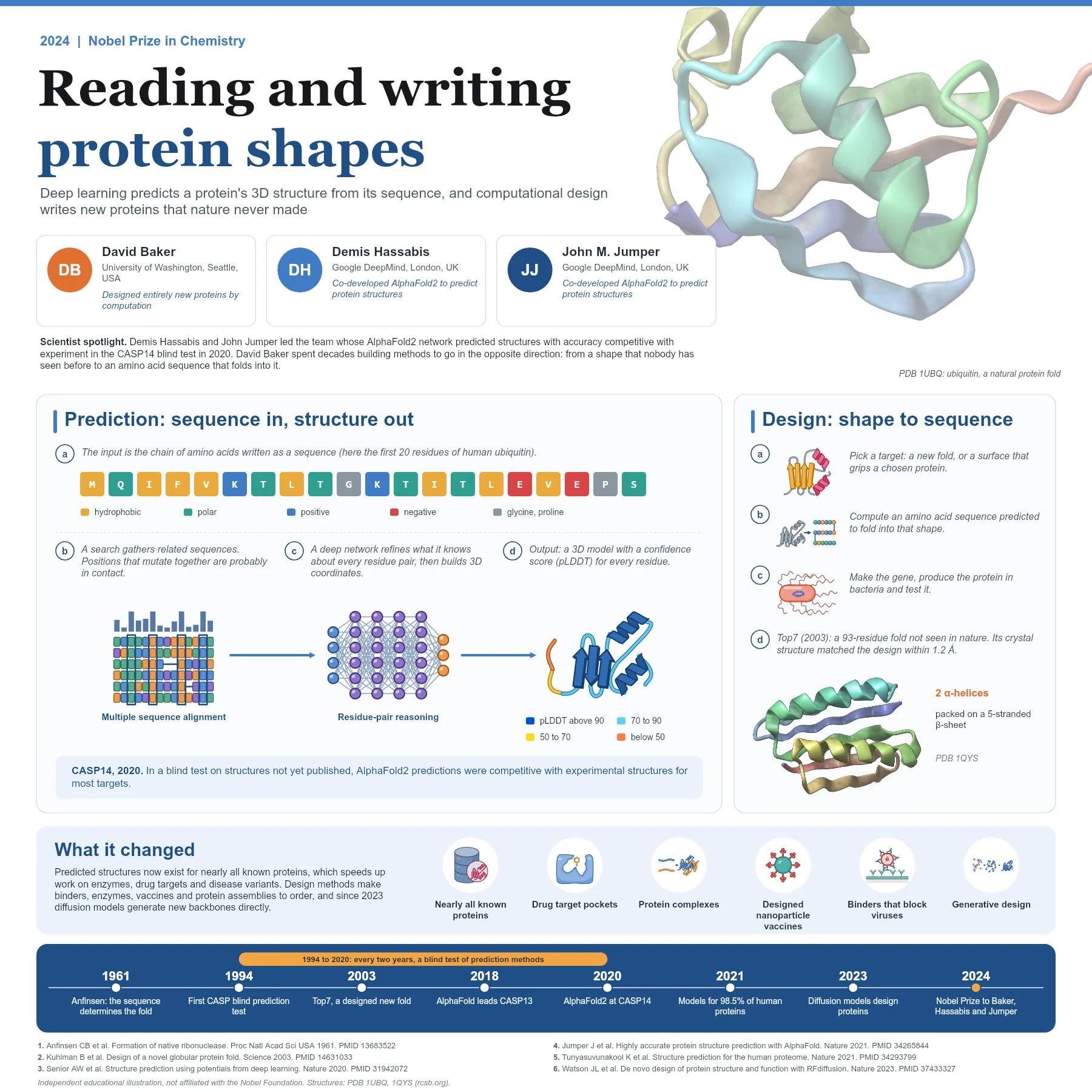
Proteins are chains of amino acids, written as a sequence of twenty possible letters. Yet they do their jobs as precise three-dimensional shapes: enzymes with pockets, receptors with binding sites, fibres and motors. In 1961 Christian Anfinsen and colleagues showed that a denatured enzyme, ribonuclease, could refold into its active form on its own, which implied that the sequence alone carries the information for the fold.
Turning that principle into prediction proved extremely hard. Experimental structures, from X-ray crystallography and later cryo-electron microscopy, took months or years each, and they covered only a small fraction of the sequences being discovered. The 2024 Nobel Prize in Chemistry was shared between David Baker, for computational protein design, and Demis Hassabis and John Jumper, for protein structure prediction.
A fair test: CASP
From 1994, the Critical Assessment of protein Structure Prediction (CASP) gave the field a blind test. Every two years, organisers collect structures that have been solved but not yet released, and groups submit predictions from sequence alone. For two decades progress was steady but slow.
In CASP13 in 2018, a deep learning system called AlphaFold from Hassabis's company led the assessment, using predicted distances between residues. Two years later, in CASP14, the redesigned AlphaFold2 led by Jumper produced models whose accuracy was competitive with experimental structures for most targets.
CASP mattered because it removed any chance of tuning a method to answers that were already known. Predictors did not have the experimental structures, assessors compared the models afterwards, and over the years the community could see which ideas really worked: modelling from related structures, assembling fragments, refining with physics, and finally inferring residue contacts from evolution.
How prediction works
AlphaFold2 starts from the sequence and searches databases for related sequences from other organisms, building a multiple sequence alignment. Positions that change together across evolution are often in contact in the folded protein, so the alignment carries hidden structural clues.
A deep neural network then refines two representations together: one for the alignment and one for every pair of residues. A structure module turns the pair information into three-dimensional coordinates, and the network repeats its reasoning on its own output. Each residue receives a confidence score, the predicted local distance difference test or pLDDT, on a scale of 0 to 100; values above 90 indicate very high confidence and values below 50 often mark disordered regions.
In 2021 the method was applied to almost the entire human proteome, 98.5% of human proteins, and predicted structures were made freely available. The collection later grew to cover nearly all known protein sequences.
Predicted models have limits worth remembering. A prediction is a single static picture, while many proteins move, change shape when they bind a partner, or contain long flexible regions. Low confidence scores flag such regions, and predicting the effect of a single mutation or the fine detail of how a small drug binds is still difficult. Experiments remain the final arbiter for the cases that matter most.
Going the other way: designing new proteins
David Baker's laboratory set out to solve the inverse problem: choose a shape, then find a sequence that folds into it. In 2003 his group reported Top7, a 93-residue protein with a fold not seen in nature, two alpha helices packed on a five-stranded beta sheet. The protein was extremely stable, and its crystal structure matched the design model to 1.2 angstrom.
Design methods have since produced enzymes, sensors, symmetric assemblies and binders that grip chosen targets. Designed protein nanoparticles that display viral antigens have been developed as vaccines, and in 2023 the diffusion model RFdiffusion generated new protein backbones directly, including binders whose experimental structures were nearly identical to the designs.
The design cycle mirrors prediction in reverse. Designers first choose a backbone, the path the chain takes in space, then search for amino acids whose side chains pack tightly in the core and keep the surface soluble. Early work used physics-based energy functions and heavy sampling; newer methods use deep networks both to generate backbones and to propose sequences for them. Promising designs become genes, are produced in bacteria and tested, and the best are checked by solving their structures.
Prediction and design also feed each other. Designers now routinely check whether a structure prediction network recovers the intended shape from a designed sequence before any gene is ordered, which raises success rates and saves months of laboratory work.
Why it matters today
Predicted structures now serve as a starting point for almost any question about a protein: where a drug might bind, how a disease mutation might disrupt a fold, or how two proteins assemble. They do not replace experiments, and confidence scores show where a model should not be trusted, but they save years of work.
Design turns this understanding into new molecules. Together, reading and writing protein shapes have changed structural biology from a field that described what nature made into one that can also build what nature never tried.
The two halves of the prize belong together for that reason. Reading shapes made the protein universe searchable; writing them made it extendable. Between them they changed structural biology from a field that described what nature had made into one that can also build what nature never tried.
Key takeaways
- A protein's sequence determines its fold (Anfinsen, 1961), but predicting it was hard for decades.
- CASP, held every two years since 1994, provides blind tests of prediction methods.
- AlphaFold2 uses sequence alignments and a deep network over residue pairs, with a per-residue confidence score (pLDDT).
- Baker's Top7 (2003) was the first designed protein with a new fold, matching its design to 1.2 angstrom.
- Design now produces binders, enzymes, assemblies and nanoparticle vaccines.
References
- Anfinsen CB, Haber E, Sela M, et al. The kinetics of formation of native ribonuclease during oxidation of the reduced polypeptide chain. Proc Natl Acad Sci U S A. 1961;47:1309-1314. PubMed 13683522
- Moult J, Pedersen JT, Judson R, et al. A large-scale experiment to assess protein structure prediction methods. Proteins. 1995;23:ii-v. PubMed 8710822
- Kuhlman B, Dantas G, Ireton GC, et al. Design of a novel globular protein fold with atomic-level accuracy. Science. 2003;302(5649):1364-1368. PubMed 14631033
- Senior AW, Evans R, Jumper J, et al. Improved protein structure prediction using potentials from deep learning. Nature. 2020;577:706-710. PubMed 31942072
- Jumper J, Evans R, Pritzel A, et al. Highly accurate protein structure prediction with AlphaFold. Nature. 2021;596(7873):583-589. PubMed 34265844
- Tunyasuvunakool K, Adler J, Wu Z, et al. Highly accurate protein structure prediction for the human proteome. Nature. 2021;596(7873):590-596. PubMed 34293799
- Walls AC, Miranda MC, Schäfer A, et al. Elicitation of broadly protective sarbecovirus immunity by receptor-binding domain nanoparticle vaccines. Cell. 2021;184:5432-5447.e16. PubMed 34619077
- Watson JL, Juergens D, Bennett NR, et al. De novo design of protein structure and function with RFdiffusion. Nature. 2023;620(7976):1089-1100. PubMed 37433327
An independent educational article and illustration by BioGein, not affiliated with or endorsed by the Nobel Foundation. Protein structures are rendered from Protein Data Bank entries (rcsb.org).