The question: can size alone change a material?
Gold is yellow, cadmium selenide is dark: we normally think of colour as a fixed property of a substance. Physicists had predicted, however, that when a crystal becomes small enough, only a few nanometres across, its electrons should feel the walls of the crystal and its properties should start to depend on its size.
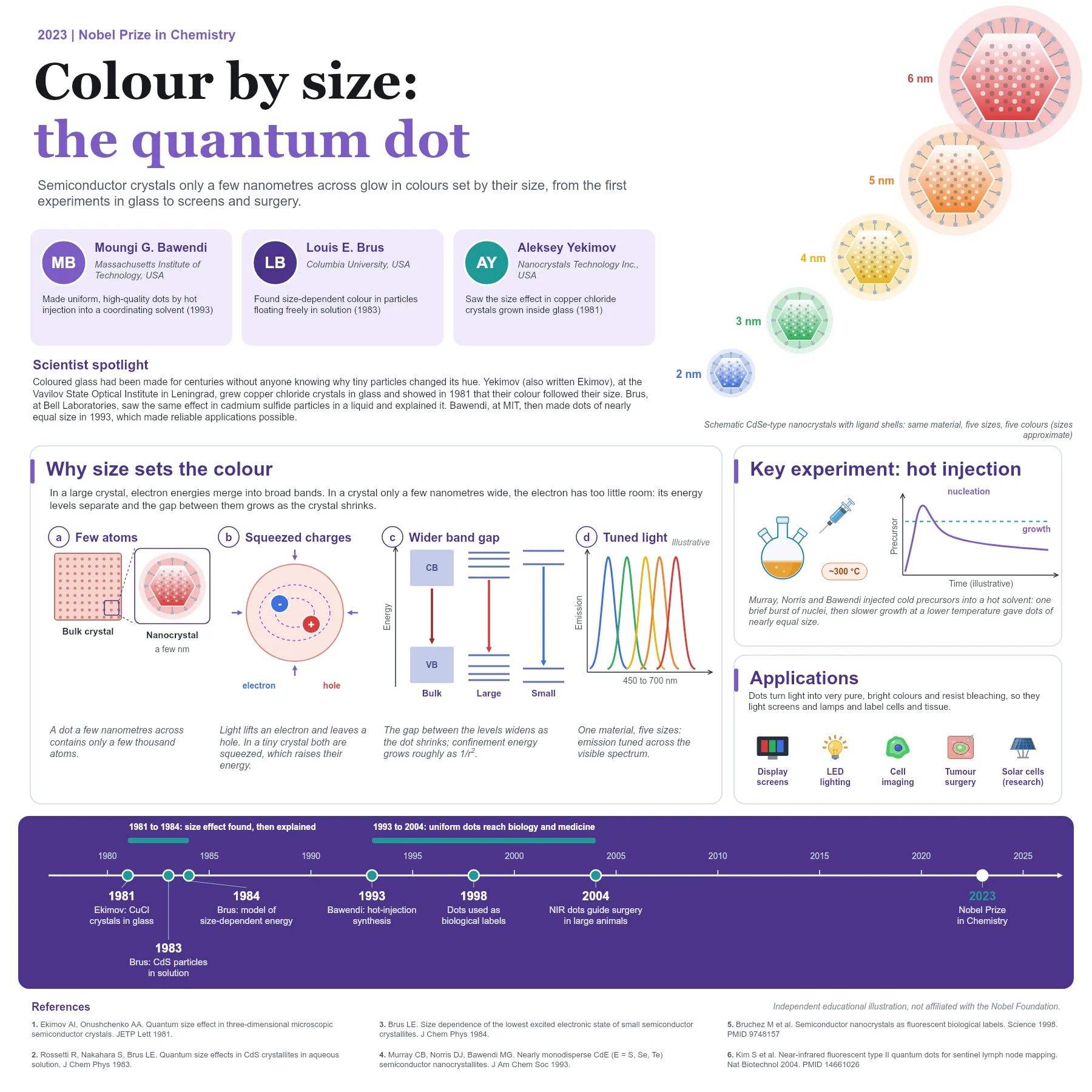
The 2023 Nobel Prize in Chemistry recognised Moungi Bawendi, Louis Brus and Aleksey Yekimov (also written Ekimov) for the discovery and synthesis of quantum dots: semiconductor nanocrystals whose colour is set by their size.
The discovery story
Coloured glass had been made for centuries with tiny particles of metals or semiconductors, without a clear explanation of why the hue varied. Yekimov, at the Vavilov State Optical Institute in Leningrad, grew copper chloride crystals inside glass by heating it for different times and temperatures. In 1981 he and Alexei Onushchenko reported that the light absorption of the glass shifted with the size of the crystals, and attributed it to a quantum size effect.
Brus, at Bell Laboratories, was studying cadmium sulfide particles suspended in a liquid. In 1983 he and his colleagues saw that the particles' optical properties changed as they grew over time, the first evidence of the effect in free particles in solution. In 1984 Brus described a model that explained how the lowest excited state rises in energy as the crystal shrinks.
Early dots, however, varied widely in size and quality. In 1993 Bawendi's group at MIT, with Christopher Murray and David Norris, introduced hot injection: cold precursors were injected quickly into a hot coordinating solvent at about 300 °C. This produced one short burst of tiny seed crystals; the mixture then cooled and the seeds grew slowly and evenly. By taking samples over time, the team obtained series of cadmium sulfide, selenide and telluride nanocrystals of nearly uniform size.
How quantum confinement works
In a large semiconductor crystal, the energies available to electrons merge into broad bands: a filled valence band and an empty conduction band, separated by a band gap. When light with enough energy is absorbed, an electron jumps across the gap and leaves behind a positively charged hole. When they recombine, light is emitted with an energy close to the gap.
In a crystal a few nanometres wide, the electron and the hole are squeezed into a space smaller than they would naturally occupy. Like a wave in a short box, they can only take certain energies, and the smaller the box, the higher those energies. The bands break up into separate levels and the effective gap widens. Confinement energy grows roughly as one over the square of the radius, so a small change in size gives a large change in colour.
The result is striking: the same material, cadmium selenide for example, glows blue when its crystals are about two nanometres across and red when they are around six. Chemists can therefore tune colour by tuning size.
Surface chemistry matters as much as size. In the hot-injection method, the crystals grow while coated with organic molecules from the solvent, which bind to surface atoms, stop the particles from sticking together and let them disperse in liquids. Later work grew a thin shell of a second semiconductor, such as zinc sulfide around cadmium selenide, which protects the core and makes the dots shine more brightly. For use in water and in living tissue, the dots are wrapped in further coatings that carry antibodies or other molecules that recognise their targets.
From discovery to applications
Uniform, bright and stable dots soon reached biology. In 1998 two papers in Science, from groups led by Paul Alivisatos and Shuming Nie, used coated nanocrystals as fluorescent labels for cells and biomolecules. Their narrow emission and resistance to bleaching made it possible to label several targets at once with a single light source.
Medicine followed. In 2004 a team including Bawendi and John Frangioni reported near-infrared quantum dots that let surgeons map sentinel lymph nodes in large animals in real time, a step towards image-guided cancer surgery. Today quantum dots also turn blue light into very pure red and green in display screens and LED lamps, and they are being studied for solar cells, sensors and quantum communication.
Why it matters today
Quantum dots made a textbook idea tangible: at the nanoscale, size is a design parameter as powerful as composition. The path from coloured glass, to particles in solution, to uniform dots made at will shows how a curious observation becomes a technology once chemists can control it. Questions about toxic elements such as cadmium are pushing research towards safer compositions, but the principle the laureates established remains the foundation.
Key takeaways
- Quantum dots are semiconductor crystals a few nanometres across whose colour depends on their size.
- Yekimov found the effect in glass in 1981, Brus in solution in 1983, and Bawendi's hot injection of 1993 made uniform dots.
- Squeezing the electron and hole raises their energy, widening the gap: smaller dots emit bluer light.
- Applications include display screens, LED lighting, biological imaging and guidance during cancer surgery.
References
- Ekimov AI, Onushchenko AA. Quantum size effect in three-dimensional microscopic semiconductor crystals. JETP Lett. 1981;34:345-349.
- Rossetti R, Nakahara S, Brus LE. Quantum size effects in the redox potentials, resonance Raman spectra, and electronic spectra of CdS crystallites in aqueous solution. J Chem Phys. 1983;79:1086-1088. DOI
- Brus LE. Electron-electron and electron-hole interactions in small semiconductor crystallites: the size dependence of the lowest excited electronic state. J Chem Phys. 1984;80:4403-4409. DOI
- Murray CB, Norris DJ, Bawendi MG. Synthesis and characterization of nearly monodisperse CdE (E = S, Se, Te) semiconductor nanocrystallites. J Am Chem Soc. 1993;115:8706-8715. DOI
- Bruchez M Jr, Moronne M, Gin P, Weiss S, Alivisatos AP. Semiconductor nanocrystals as fluorescent biological labels. Science. 1998;281(5385):2013-2016. PubMed 9748157
- Chan WC, Nie S. Quantum dot bioconjugates for ultrasensitive nonisotopic detection. Science. 1998;281(5385):2016-2018. PubMed 9748158
- Kim S, Lim YT, Soltesz EG, et al. Near-infrared fluorescent type II quantum dots for sentinel lymph node mapping. Nat Biotechnol. 2004;22(1):93-97. PubMed 14661026
An independent educational article and illustration by BioGein, not affiliated with or endorsed by the Nobel Foundation. Protein structures are rendered from Protein Data Bank entries (rcsb.org).