The question: who were our closest relatives?
Fossils tell us that modern humans once shared the world with other hominin groups, such as the Neanderthals, who lived in Europe and western Asia. Bones can show how these groups looked, but they cannot easily answer other questions. How closely were Neanderthals related to us? Did the groups meet and have children together? And did any of their DNA survive in people living today?
Answering these questions required reading DNA from bones tens of thousands of years old. That was long thought impossible, because DNA breaks down after death and ancient samples are easily contaminated with DNA from bacteria and from the people who handle them.
Genetics offered another route. Comparing DNA from living people had already suggested that modern humans arose in Africa and later spread across the world. But living people alone could not reveal whether our ancestors mixed with the groups they met along the way. Only DNA from the extinct groups themselves could test that directly, and that is the problem Pääbo set out to solve.
The discovery story
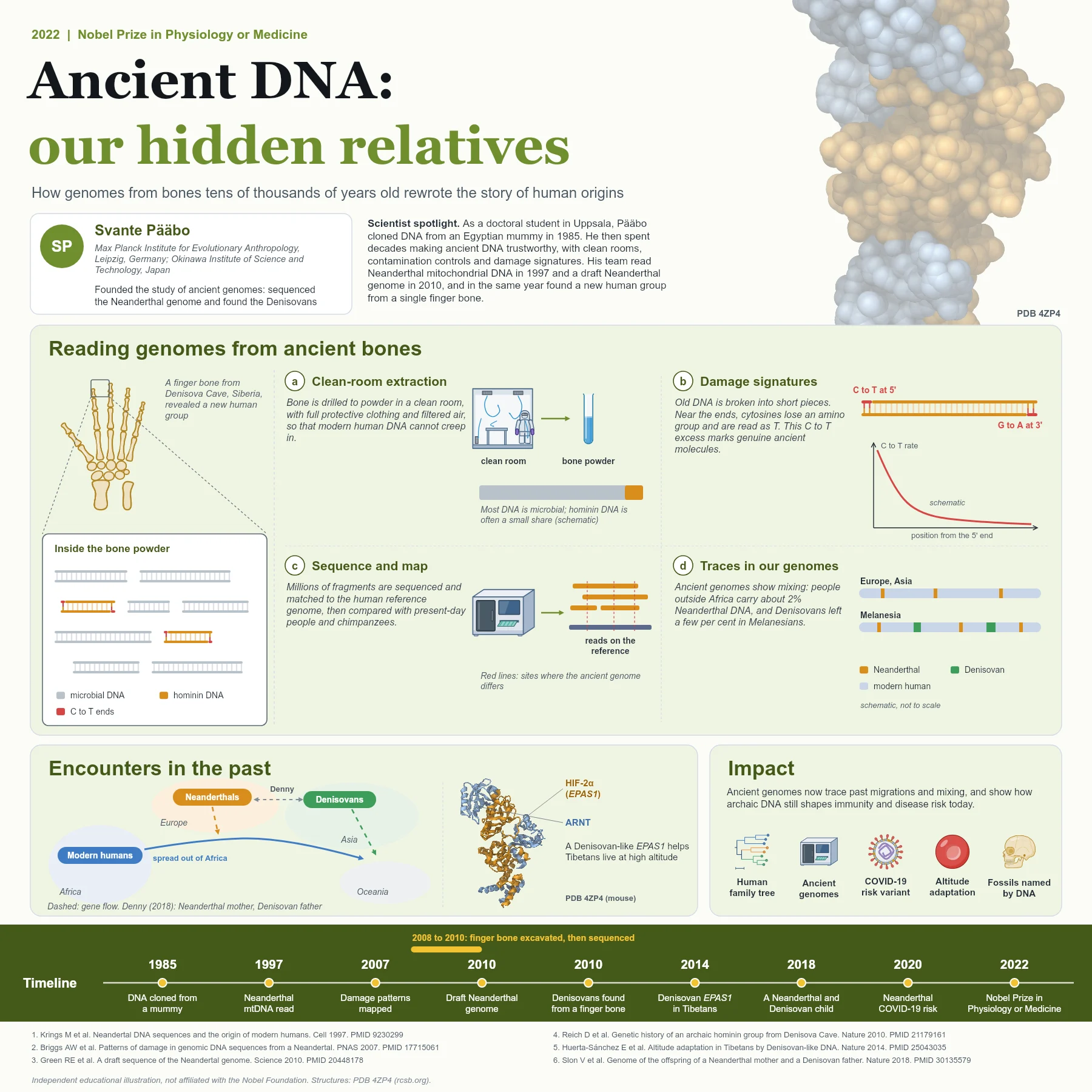
As a doctoral student in Uppsala, Svante Pääbo reported in 1985 that he had cloned DNA from an Egyptian mummy. He then spent many years making ancient DNA research reliable. His groups built clean rooms, used strict controls for contamination, and studied the chemical damage typical of old DNA so that genuine ancient molecules could be told apart from modern ones.
In 1997 his team published mitochondrial DNA sequences from the original Neanderthal fossil found in Germany in the nineteenth century. The sequences lay outside the range of present-day humans, showing that Neanderthals were a distinct group. New sequencing machines later made it possible to read whole genomes, and in 2010 his team published a draft sequence of the Neanderthal genome.
The same year brought a surprise. DNA from a small finger bone excavated in 2008 in Denisova Cave, in the Altai Mountains of southern Siberia, did not match Neanderthals or modern humans. Its mitochondrial genome and then its nuclear genome revealed a previously unknown group, now called the Denisovans, known at first almost entirely from DNA.
How ancient genomes are read
Researchers drill a little powder from a bone or tooth inside a clean room, wearing protective clothing so that their own DNA does not get into the sample. Most of the DNA extracted usually comes from microbes that lived in the bone after death, and the hominin share is often small.
The surviving DNA is broken into short fragments. Near the ends of these fragments, cytosines often lose an amino group and become uracil, which sequencing reads as thymine. This excess of C to T changes at the ends of molecules is a hallmark of authentic ancient DNA and helps to separate it from modern contamination.
Millions of fragments are sequenced, matched to the human reference genome and compared with present-day people and with chimpanzees. Statistical comparisons then reveal which variants each group shares, and in what proportions.
What the genomes revealed
The draft Neanderthal genome showed that Neanderthals share more genetic variants with people from outside Africa than with people from Africa. The best explanation is gene flow: modern humans who spread out of Africa met Neanderthals and had children with them. People outside Africa today carry about two per cent Neanderthal DNA.
The Denisovan genome showed that Denisovans were a sister group of the Neanderthals and that they too mixed with modern humans; the first analysis estimated that they contributed four to six per cent of the genomes of present-day Melanesians. In 2018 the genome of a bone fragment from Denisova Cave revealed a girl whose mother was a Neanderthal and whose father was a Denisovan.
Some archaic DNA has had lasting effects. A Denisovan-like version of the gene EPAS1, which encodes the oxygen-sensing transcription factor HIF-2 alpha, is common in Tibetans and helps them live at high altitude. A stretch of DNA inherited from Neanderthals was found in 2020 to be the major genetic risk factor for severe COVID-19.
Why it matters today
Pääbo's work founded a new field, palaeogenomics. Ancient genomes from thousands of individuals now trace the migrations and mixing of past populations, and they help to explain how variants inherited from archaic relatives affect our immune systems and disease risks. The prize also shows how methods built with great care, here clean rooms and damage signatures, can turn an impossible measurement into a routine one.
Key takeaways
- Ancient DNA is short, mostly microbial and marked by C to T changes at fragment ends, which help prove it is authentic.
- Neanderthal mitochondrial DNA (1997) and a draft Neanderthal genome (2010) showed a distinct group that mixed with modern humans.
- Denisovans were discovered in 2010 from the DNA of a finger bone found in Denisova Cave.
- People outside Africa carry about two per cent Neanderthal DNA, and Melanesians also carry Denisovan DNA.
- Archaic variants still matter: a Denisovan-like EPAS1 helps Tibetans at altitude, and a Neanderthal segment raises the risk of severe COVID-19.
References
- Pääbo S. Molecular cloning of Ancient Egyptian mummy DNA. Nature. 1985;314(6012):644-5. PubMed 3990798
- Krings M, Stone A, Schmitz RW, et al. Neandertal DNA sequences and the origin of modern humans. Cell. 1997;90(1):19-30. PubMed 9230299
- Briggs AW, Stenzel U, Johnson PL, et al. Patterns of damage in genomic DNA sequences from a Neandertal. Proc Natl Acad Sci U S A. 2007;104(37):14616-21. PubMed 17715061
- Green RE, Krause J, Briggs AW, et al. A draft sequence of the Neandertal genome. Science. 2010;328(5979):710-722. PubMed 20448178
- Krause J, Fu Q, Good JM, et al. The complete mitochondrial DNA genome of an unknown hominin from southern Siberia. Nature. 2010;464(7290):894-7. PubMed 20336068
- Reich D, Green RE, Kircher M, et al. Genetic history of an archaic hominin group from Denisova Cave in Siberia. Nature. 2010;468(7327):1053-60. PubMed 21179161
- Huerta-Sánchez E, Jin X, Asan, et al. Altitude adaptation in Tibetans caused by introgression of Denisovan-like DNA. Nature. 2014;512(7513):194-7. PubMed 25043035
- Slon V, Mafessoni F, Vernot B, et al. The genome of the offspring of a Neanderthal mother and a Denisovan father. Nature. 2018;561(7721):113-116. PubMed 30135579
- Zeberg H, Pääbo S. The major genetic risk factor for severe COVID-19 is inherited from Neanderthals. Nature. 2020;587(7835):610-612. PubMed 32998156
An independent educational article and illustration by BioGein, not affiliated with or endorsed by the Nobel Foundation. Protein structures are rendered from Protein Data Bank entries (rcsb.org).