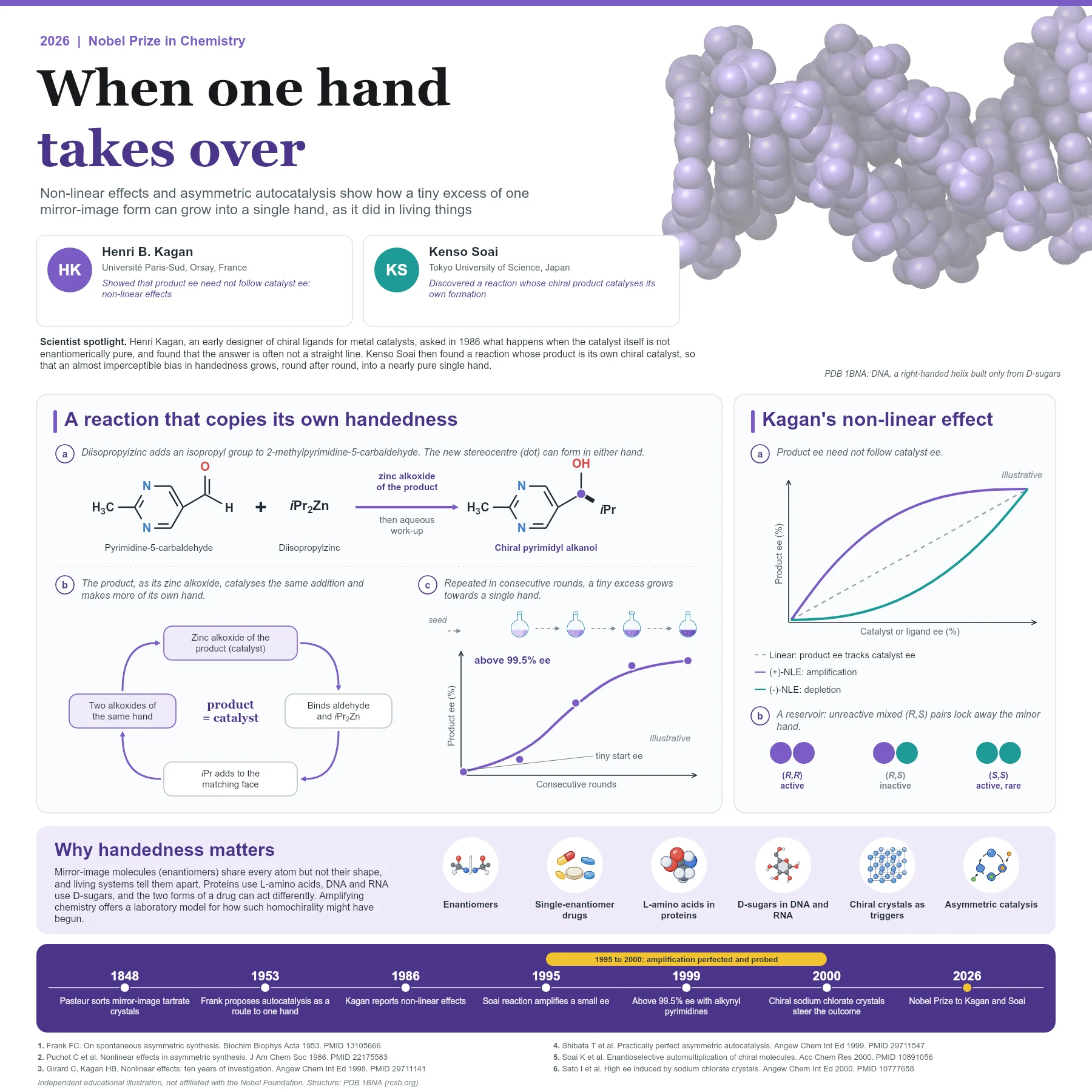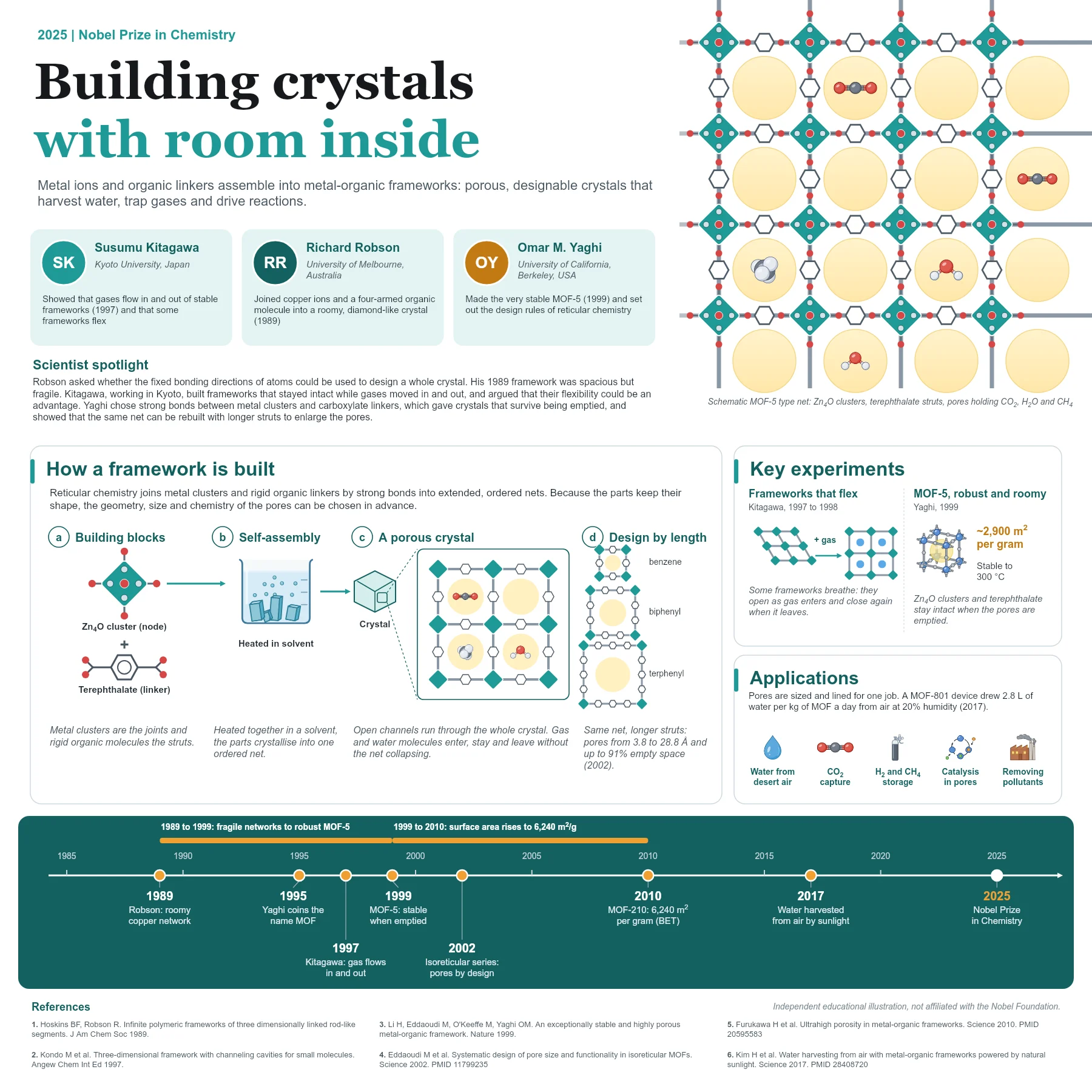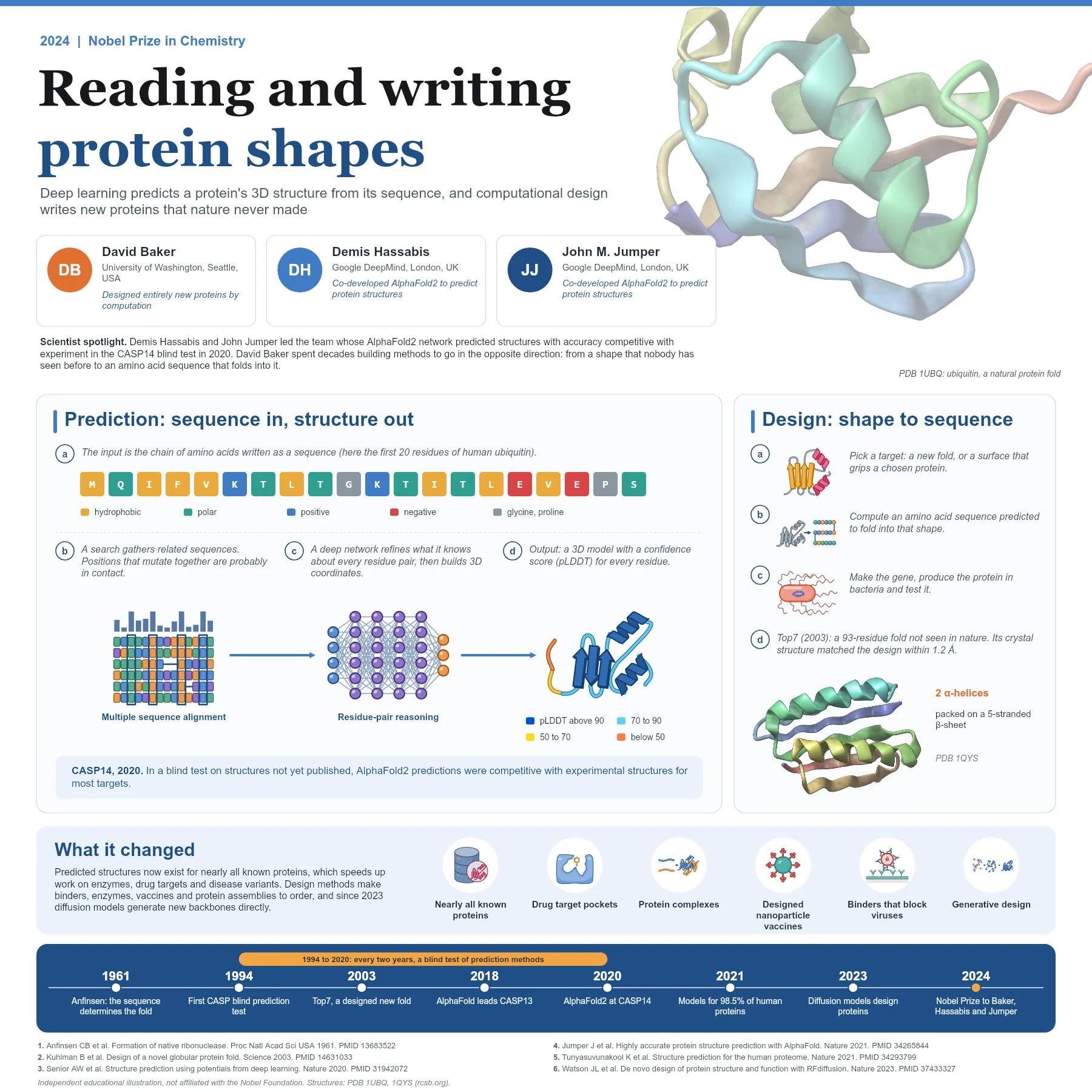
The question: can joining molecules be made simple?
Building complex molecules often takes many steps, each with side products and losses. K. Barry Sharpless, who had already shared the 2001 Nobel Prize in Chemistry, argued that chemists could instead assemble useful molecules from small building blocks using a handful of near-perfect reactions. In 2001 he and his colleagues called this approach click chemistry: reactions that are modular, give very high yields, produce only harmless by-products, and work under simple conditions, ideally in water.
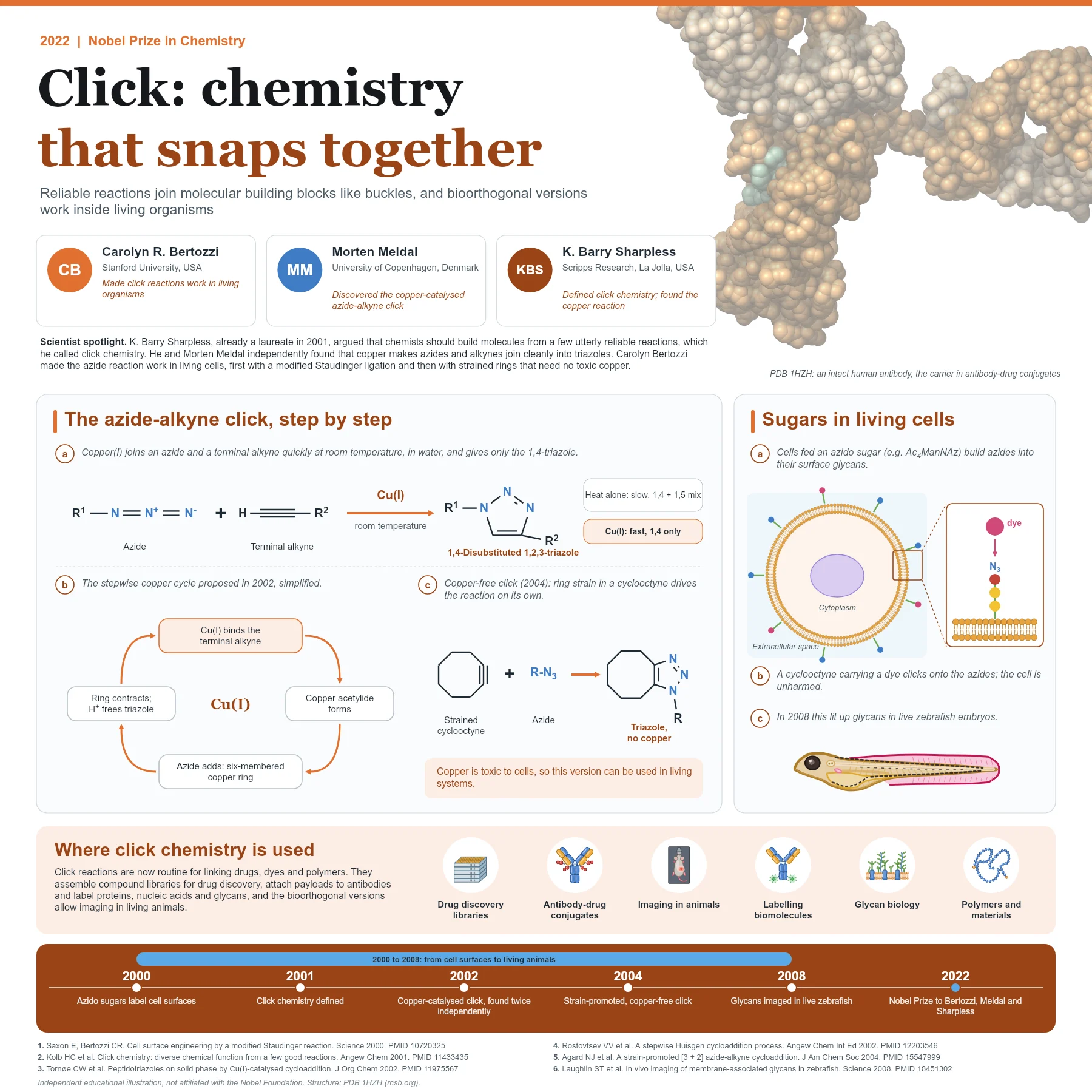
The 2022 Nobel Prize in Chemistry recognised Carolyn R. Bertozzi, Morten Meldal and K. Barry Sharpless for the development of click chemistry and bioorthogonal chemistry.
The appeal of such reactions is practical. If a connection always works, in water, at room temperature and without protecting other groups, then molecules can be built the way components are bolted together, and large collections of compounds can be made quickly and tested.
The copper-catalysed azide-alkyne click
Azides and alkynes had long been known to combine into five-membered triazole rings, but on heating the reaction is slow and gives a mixture of two isomers. In 2002 two groups independently reported that copper(I) changes everything. Meldal's group in Copenhagen, working on peptides on solid supports, and Sharpless's group in La Jolla found that copper catalysis joins terminal alkynes and azides quickly at room temperature and gives only the 1,4-disubstituted 1,2,3-triazole.
Sharpless and colleagues proposed a stepwise cycle: copper binds the alkyne and forms a copper acetylide, the azide adds to give a six-membered copper-containing ring, the ring contracts, and protonation releases the triazole and frees the copper. The reaction tolerates water and most other functional groups, which made it the archetypal click reaction.
Azides and alkynes are good partners for another reason: both are small, easy to install, and almost absent from biology, so they rarely interfere with anything else in a mixture. The triazole ring that forms is chemically robust and roughly the size of a peptide bond, which makes it a useful linker in its own right.
The reaction spread quickly because it asked so little of the chemist. It works on solid supports in peptide synthesis, in water, in the presence of amines, alcohols and acids, and at concentrations low enough to be convenient for biology.
Bioorthogonal chemistry: reactions inside life
Carolyn Bertozzi wanted to study glycans, the sugar chains on cell surfaces, which cannot be tagged genetically like proteins. In 2000 she and Eliana Saxon fed cells an unnatural sugar carrying an azide group. The cells built the azide into their surface glycoconjugates, and a modified Staudinger ligation with an engineered phosphine attached a tag to it. Neither partner reacts with anything else in the cell, which is what bioorthogonal means.
Copper is toxic to cells, so the copper-catalysed click was not suitable for living systems. In 2004 Bertozzi's group introduced a strain-promoted cycloaddition: bending the alkyne into an eight-membered ring stores strain, and the cyclooctyne reacts with azides under physiological conditions without any catalyst. In 2008 the group used this copper-free click to image glycans in live, developing zebrafish embryos, revealing where new glycans are made.
The strategy behind Bertozzi's work has two stages. First a chemical reporter, here an azide, is smuggled into a biomolecule by the cell's own machinery, which treats the unnatural sugar as an ordinary building block. Then a probe carrying a dye or a tag is added, and it reacts only with that reporter. Because neither partner reacts with the thousands of other functional groups in a cell, the label ends up only where it should.
Strained cyclooctynes were tuned over several generations for faster reaction and better solubility, and related bioorthogonal reactions were added to the toolkit, so that two or three different labels can now be followed at once.
From discovery to applications
Click reactions are now routine wherever molecules must be joined reliably. They assemble compound libraries in drug discovery, link fluorescent dyes, biotin or drugs to proteins and nucleic acids, build polymers and materials, and help attach payloads to antibodies in the development of antibody-drug conjugates.
Bioorthogonal reactions let researchers label and follow biomolecules in living cells and animals, and they are being explored for targeting and releasing medicines inside the body.
In medicine, bioorthogonal chemistry is being explored for assembling or releasing drugs at a chosen site: one component is sent to a tumour, the second is given later, and the reaction between them happens only where both are present.
Why it matters today
Click chemistry shows the power of choosing reactions for reliability rather than novelty. A small set of dependable connections, used over and over, can build an enormous variety of molecules. Bioorthogonal chemistry extended that idea into living systems, giving chemists a way to work inside biology without disturbing it.
Key takeaways
- Click chemistry uses a few reliable, high-yielding reactions with harmless by-products (2001).
- Copper(I) makes azides and terminal alkynes form only 1,4-disubstituted 1,2,3-triazoles, found independently by Meldal and Sharpless in 2002.
- Bertozzi labelled cell-surface glycans with azido sugars (2000) and removed the need for copper with strained cyclooctynes (2004).
- Copper-free click imaged glycans in live zebrafish embryos (2008).
- Applications include drug discovery, bioconjugation, materials and imaging in living animals.
References
- Saxon E, Bertozzi CR. Cell surface engineering by a modified Staudinger reaction. Science. 2000;287(5460):2007-2010. PubMed 10720325
- Kolb HC, Finn MG, Sharpless KB. Click chemistry: diverse chemical function from a few good reactions. Angew Chem Int Ed Engl. 2001;40(11):2004-2021. PubMed 11433435
- Tornøe CW, Christensen C, Meldal M. Peptidotriazoles on solid phase: [1,2,3]-triazoles by regiospecific copper(I)-catalyzed 1,3-dipolar cycloadditions of terminal alkynes to azides. J Org Chem. 2002;67(9):3057-3064. PubMed 11975567
- Rostovtsev VV, Green LG, Fokin VV, Sharpless KB. A stepwise Huisgen cycloaddition process: copper(I)-catalyzed regioselective ligation of azides and terminal alkynes. Angew Chem Int Ed Engl. 2002;41(14):2596-2599. PubMed 12203546
- Agard NJ, Prescher JA, Bertozzi CR. A strain-promoted [3 + 2] azide-alkyne cycloaddition for covalent modification of biomolecules in living systems. J Am Chem Soc. 2004;126(46):15046-15047. PubMed 15547999
- Laughlin ST, Baskin JM, Amacher SL, Bertozzi CR. In vivo imaging of membrane-associated glycans in developing zebrafish. Science. 2008;320(5876):664-667. PubMed 18451302
An independent educational article and illustration by BioGein, not affiliated with or endorsed by the Nobel Foundation. Protein structures are rendered from Protein Data Bank entries (rcsb.org).