The question: how does a nerve ending sense the world?
We feel the warmth of the sun, the chill of a cold drink and the light brush of a feather. Each of these sensations begins in the endings of sensory neurons, whose cell bodies sit in the dorsal root and trigeminal ganglia. For a long time it was not clear which molecules in those endings detect heat, cold or pressure and turn them into electrical signals.
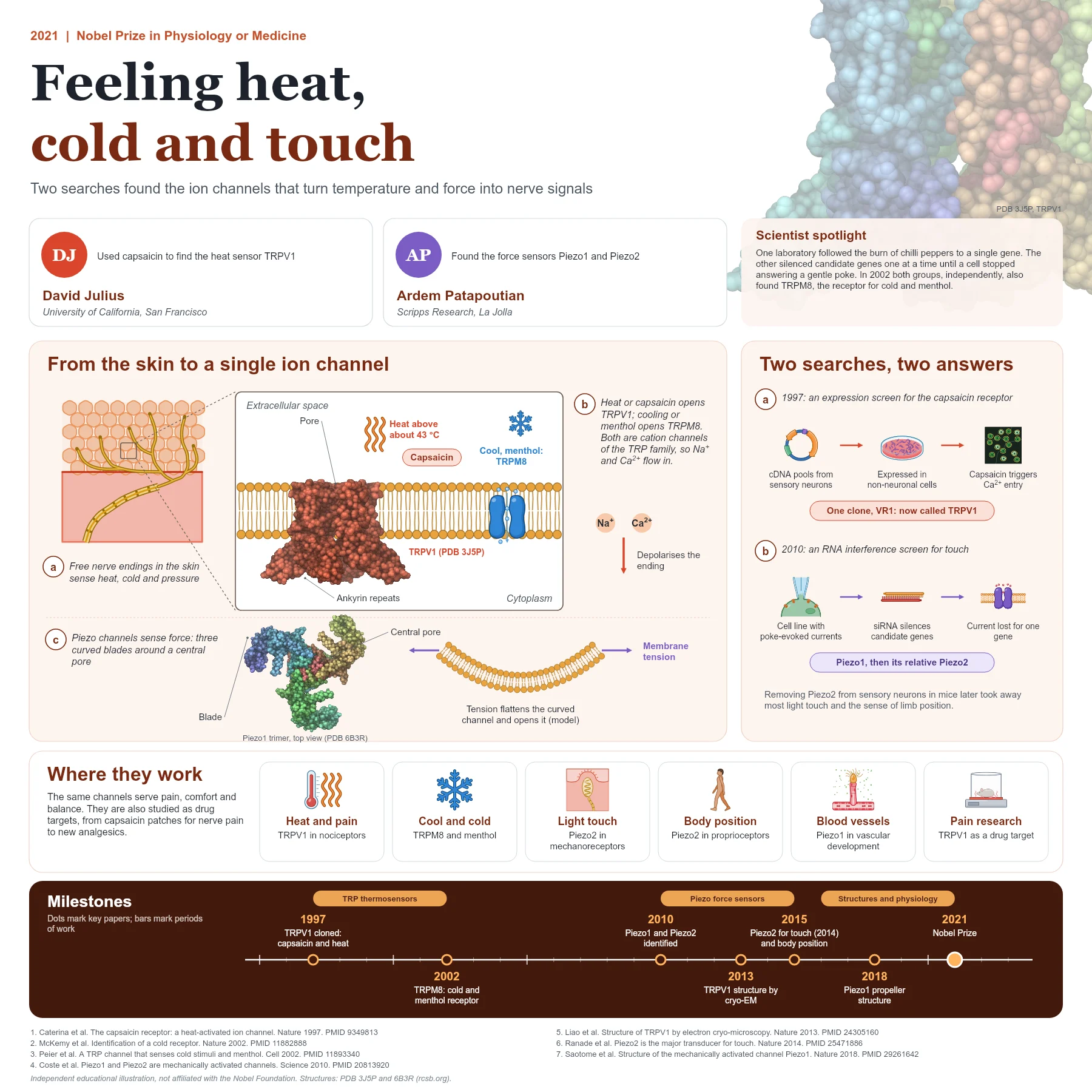
The 2021 Nobel Prize in Physiology or Medicine went to David Julius and Ardem Patapoutian for discovering receptors for temperature and touch. Both answers turned out to be ion channels: proteins that open a pore in the membrane when they sense their stimulus.
A chilli pepper leads to the heat sensor
Capsaicin, the pungent compound in chilli peppers, causes a burning pain by activating sensory neurons that report noxious stimuli. Julius and his colleagues reasoned that a receptor for capsaicin should exist and set out to find its gene.
They made a library of cDNA from sensory neurons and expressed pools of it in cultured non-neuronal cells, then looked for cells in which capsaicin triggered an influx of calcium. By dividing positive pools again and again they isolated a single clone. In 1997 they reported that it encodes a cation channel related to the TRP family, which they called VR1 and which is now named TRPV1. Remarkably, the channel was also opened by heat in the painful range, so the same molecule senses both chilli and dangerous heat.
In 2002 the Julius laboratory and, independently, the Patapoutian laboratory identified TRPM8, a related channel activated by cool temperatures and by menthol. Together these discoveries showed that TRP channels detect temperature over a wide range.
TRPM8 is expressed in a distinct subset of pain- and temperature-sensing neurons, separate from many of those that carry TRPV1, which helped explain how different nerve fibres report warmth, cooling and pain.
A gentle poke leads to the touch sensors
Mechanical senses posed a harder problem, because there was no chemical like capsaicin to guide the search. Patapoutian and colleagues found a mouse neuroblastoma cell line that produced an electrical current when poked with a fine probe. They drew up a list of candidate genes and silenced them one by one with RNA interference.
In 2010 they reported that knocking down one gene, which they named Piezo1, abolished the mechanically activated current. A related gene, Piezo2, produced a different mechanically activated current and was needed for rapidly adapting currents in sensory neurons. Piezo1 and Piezo2 were large membrane proteins unlike any known channel.
Later work in mice showed that Piezo2 is the main transducer for light touch (2014) and for proprioception, the sense of the position of the body and limbs (2015).
Mice lacking Piezo2 in adult sensory neurons and Merkel cells lost almost all light-touch sensation, while other skin senses remained, which showed that touch and pain can be separated at the molecular level. When Piezo2 was removed from proprioceptive neurons, the animals showed uncoordinated movements and abnormal limb positions, and stretch-induced firing from muscle sensors was strongly reduced.
How the channels work
TRPV1 is built from four identical subunits around a central pore. In 2013 Julius and Yifan Cheng used electron cryo-microscopy to determine its structure at 3.4 Å resolution (PDB 3J5P), revealing the pore, the voltage-sensor-like domains around it and the ankyrin repeats in the cytoplasm. Heat or capsaicin opens the pore and lets sodium and calcium ions in, which depolarises the nerve ending and starts action potentials that travel to the spinal cord.
Piezo1 forms a trimer with three long curved blades around a central pore, giving it a propeller shape seen in cryo-EM structures (PDB 6B3R). The curved transmembrane region is thought to sense tension in the membrane: when the membrane is stretched, the channel is proposed to flatten and open, letting cations into the cell.
The TRPV1 structure showed fourfold symmetry like voltage-gated channels, a wide extracellular mouth and a short selectivity filter. The Piezo1 structure revealed at least 26 transmembrane helices per subunit, arranged in repeated four-helix bundles, with the pore closed by constrictions on the cytoplasmic side.
Why it matters today
These channels explain everyday sensations and some of our protective reflexes. TRPV1 is central to research on pain and inflammation, and high-concentration capsaicin patches are used to treat some forms of nerve pain. Piezo2 underlies touch and body awareness, while Piezo1 acts in many tissues, including the developing vascular system.
The two discoveries also show two complementary search strategies: following a natural chemical to its receptor, and systematically silencing genes until a cellular response disappears.
Key takeaways
- TRPV1, found with capsaicin in 1997, is a cation channel opened by noxious heat.
- TRPM8, found in 2002 by both laboratories, senses cool temperatures and menthol.
- Piezo1 and Piezo2, found in 2010 by an RNA interference screen, are mechanically activated cation channels.
- Piezo2 is the main sensor for light touch and proprioception in mice.
- Cryo-EM structures of TRPV1 and Piezo1 show how these channels are built.
References
- Caterina MJ, Schumacher MA, Tominaga M, et al. The capsaicin receptor: a heat-activated ion channel in the pain pathway. Nature. 1997;389(6653):816-24. PubMed 9349813
- McKemy DD, Neuhausser WM, Julius D. Identification of a cold receptor reveals a general role for TRP channels in thermosensation. Nature. 2002;416(6876):52-8. PubMed 11882888
- Peier AM, Moqrich A, Hergarden AC, et al. A TRP channel that senses cold stimuli and menthol. Cell. 2002;108(5):705-15. PubMed 11893340
- Coste B, Mathur J, Schmidt M, et al. Piezo1 and Piezo2 are essential components of distinct mechanically activated cation channels. Science. 2010;330(6000):55-60. PubMed 20813920
- Liao M, Cao E, Julius D, Cheng Y. Structure of the TRPV1 ion channel determined by electron cryo-microscopy. Nature. 2013;504(7478):107-12. PubMed 24305160
- Ranade SS, Woo SH, Dubin AE, et al. Piezo2 is the major transducer of mechanical forces for touch sensation in mice. Nature. 2014;516(7529):121-5. PubMed 25471886
- Woo SH, Lukacs V, de Nooij JC, et al. Piezo2 is the principal mechanotransduction channel for proprioception. Nat Neurosci. 2015;18(12):1756-62. PubMed 26551544
- Saotome K, Murthy SE, Kefauver JM, et al. Structure of the mechanically activated ion channel Piezo1. Nature. 2018;554(7693):481-486. PubMed 29261642
An independent educational article and illustration by BioGein, not affiliated with or endorsed by the Nobel Foundation. Protein structures are rendered from Protein Data Bank entries (rcsb.org).