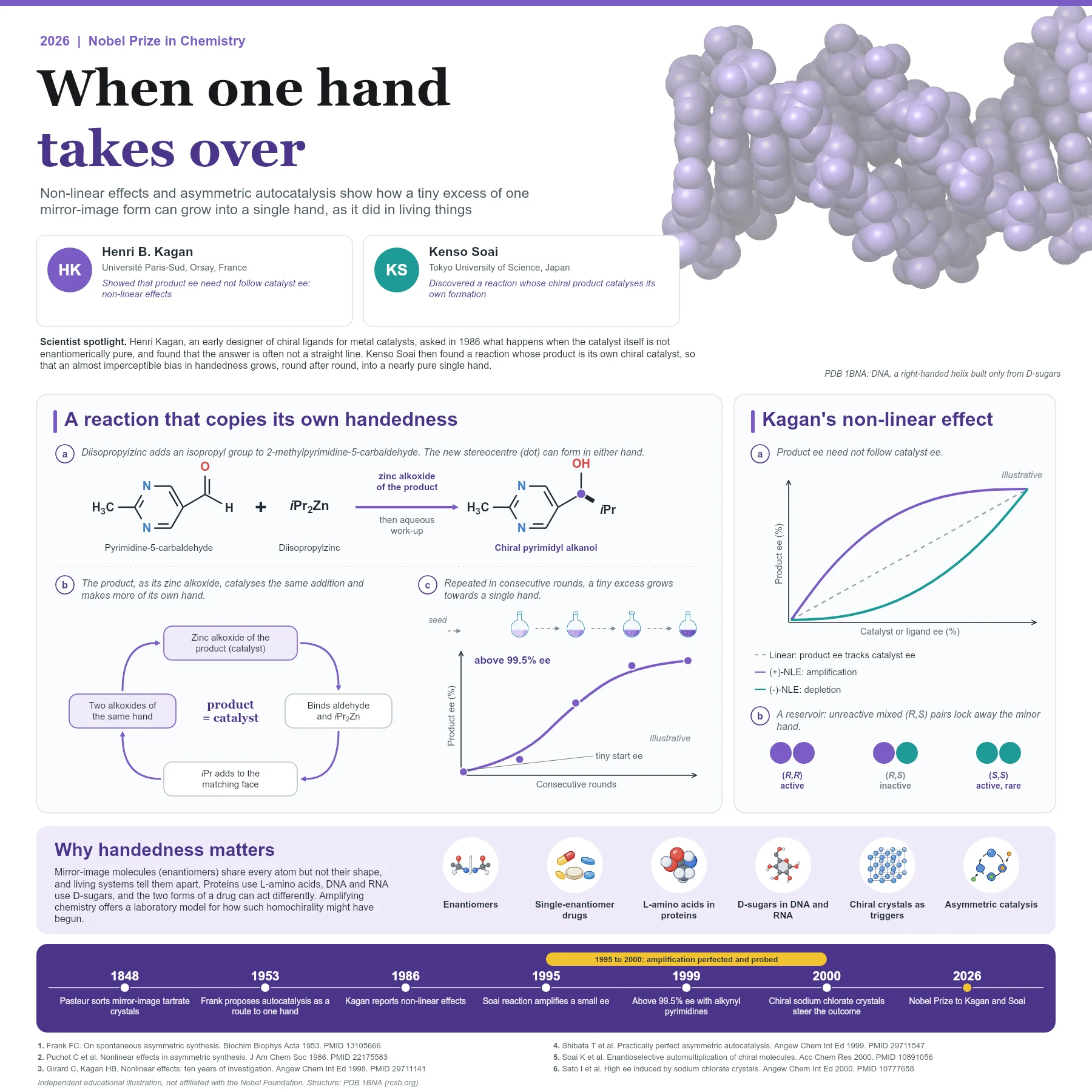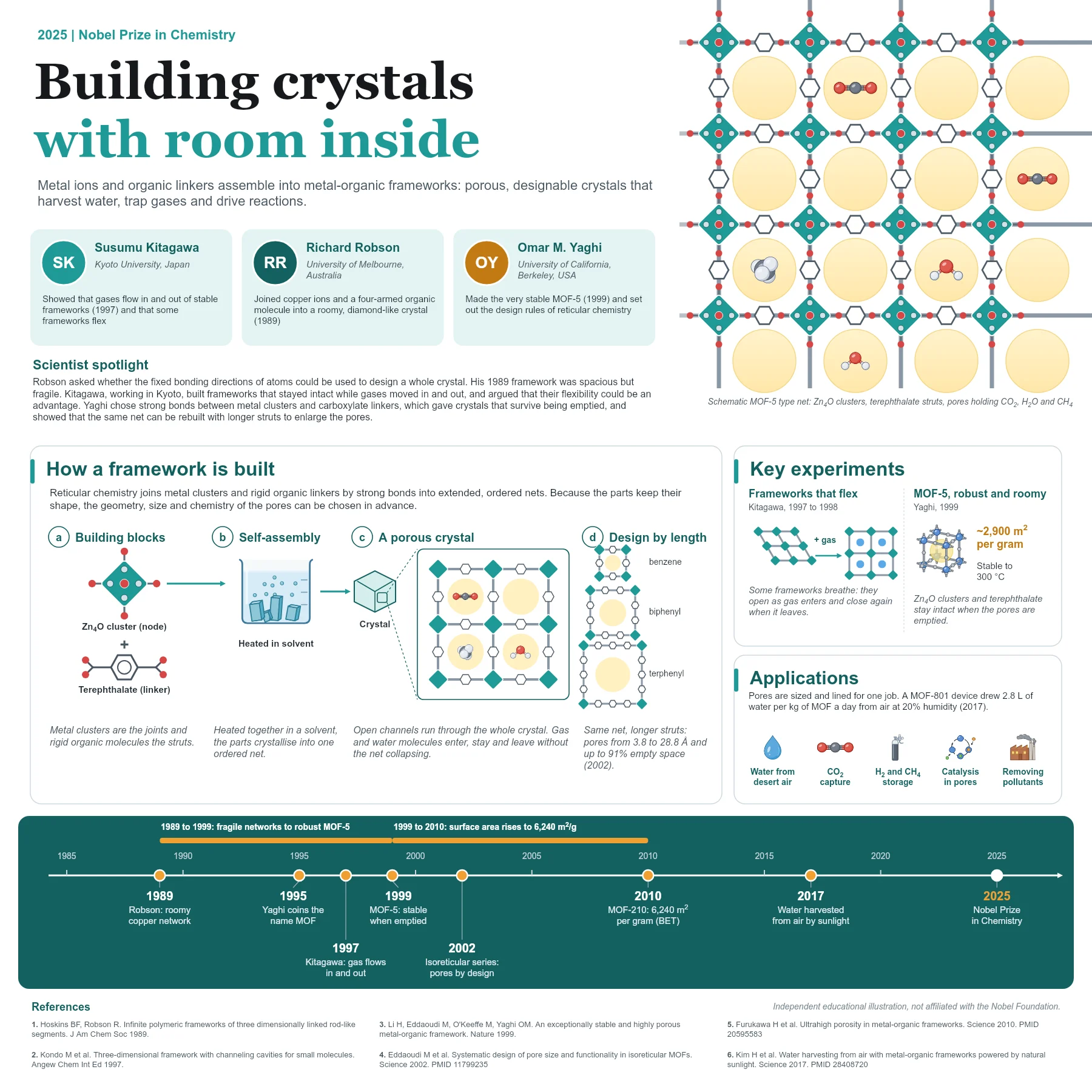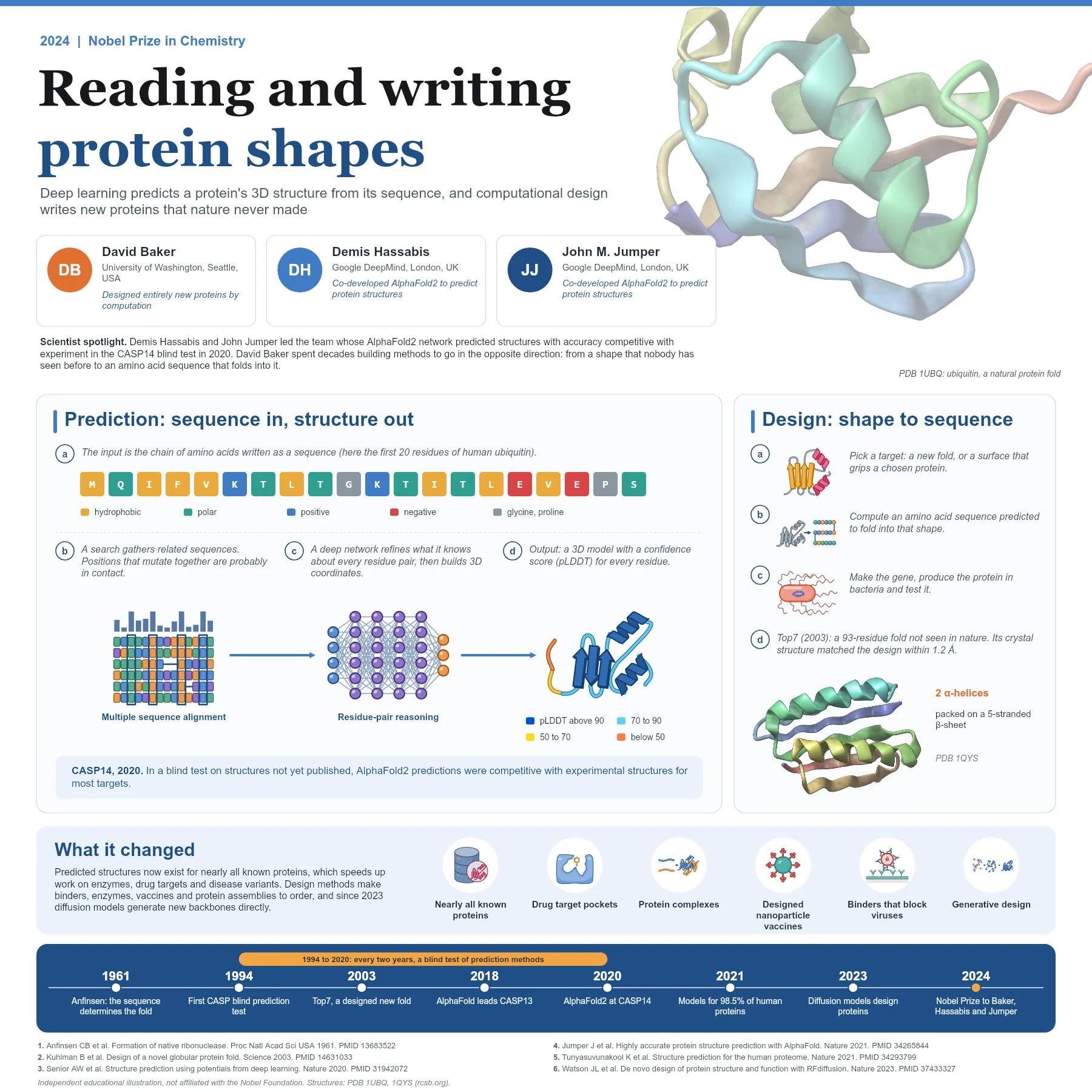
The question: must a chiral catalyst be a metal or an enzyme?
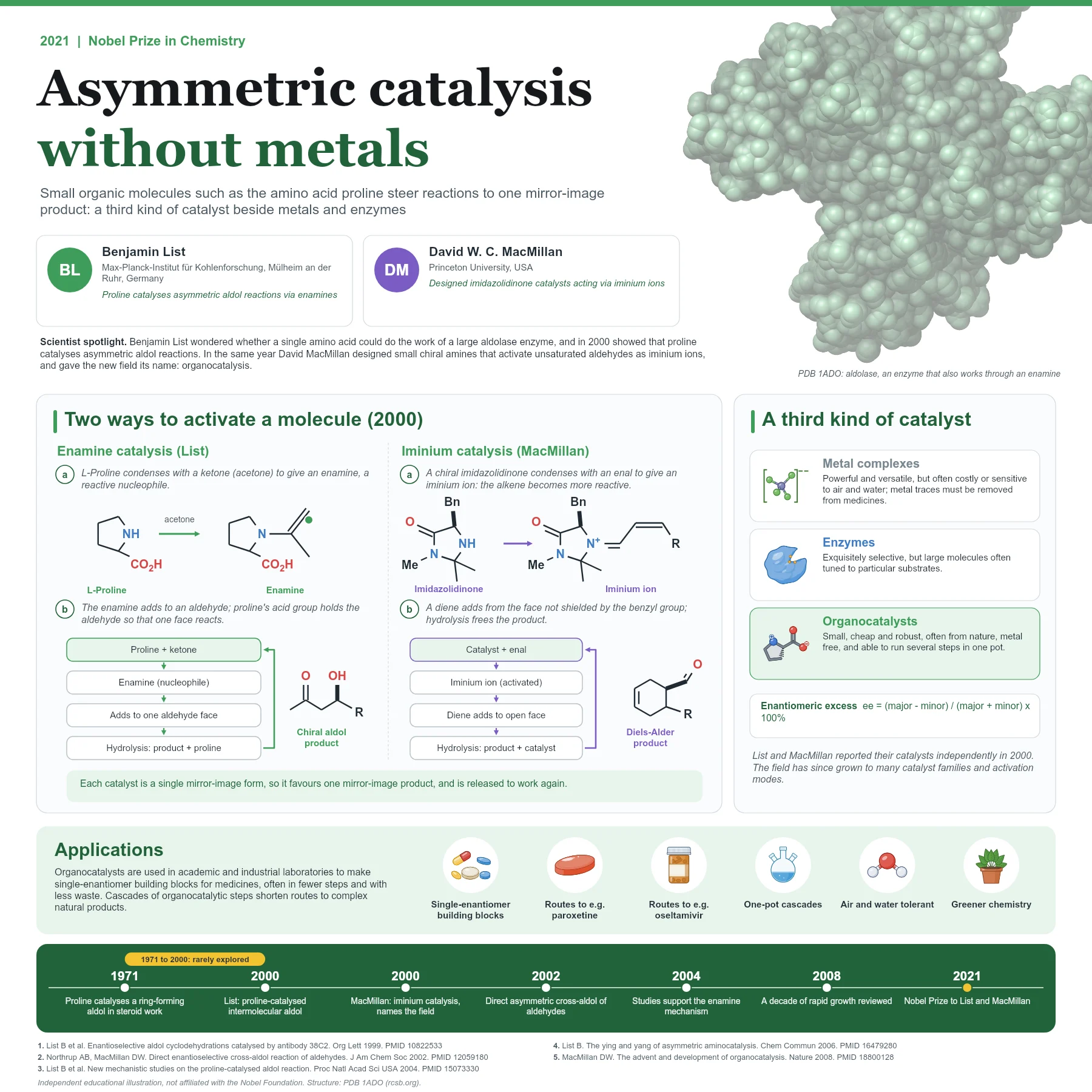
Many medicines are chiral: they exist as two mirror-image forms, and often only one is wanted. Chemists make a single form with asymmetric catalysts, and for a long time these fell into two families. Metal complexes with chiral ligands are powerful and versatile, but can be costly or sensitive to air and water, and traces of metal must be removed from drugs. Enzymes are exquisitely selective, but they are large molecules often tuned to particular substrates.
The 2021 Nobel Prize in Chemistry recognised Benjamin List and David W. C. MacMillan for developing a third family: asymmetric organocatalysis, in which small organic molecules do the job.
List and proline: an amino acid as an enzyme mimic
Benjamin List had been working with catalytic antibodies that imitate aldolase enzymes. Class I aldolases use a lysine side chain to turn a ketone into a reactive enamine, which then attacks an aldehyde to form a new carbon-carbon bond. In a 1999 study of an aldolase antibody, List and his colleagues compared it with the amino acid proline, which had been known since 1971 to catalyse an intramolecular aldol reaction used in steroid synthesis.
In 2000 List, with Richard Lerner and Carlos Barbas, showed that L-proline alone catalyses direct asymmetric aldol reactions between acetone and aldehydes. The secondary amine of proline condenses with the ketone to form an enamine, and the carboxylic acid group holds the aldehyde by hydrogen bonding so that one face reacts preferentially. Hydrolysis then releases the chiral aldol product and regenerates proline. Later mechanistic studies supported this enamine pathway.
The choice of proline was not accidental. It is a cheap, naturally occurring amino acid available in both mirror-image forms, and its ring holds a secondary amine next to a carboxylic acid, so a single small molecule provides both the group that forms the enamine and the acid that steers the incoming aldehyde. In effect it is a minimal version of an aldolase active site.
MacMillan and the iminium ion
At the same time, David MacMillan was looking for catalysts that would be easy to make and handle. He designed chiral imidazolidinones, small amines derived from an amino acid, that condense with alpha,beta-unsaturated aldehydes to form iminium ions. Forming the positively charged iminium lowers the energy of the lowest unoccupied molecular orbital, making the carbon-carbon double bond more reactive, in the same way that a Lewis acid activates a carbonyl.
In 2000 MacMillan's group used this activation for the first highly enantioselective organocatalytic Diels-Alder reaction. The benzyl group of the catalyst shields one face of the iminium ion, so the diene adds from the other face. In the same paper MacMillan named the field organocatalysis. His group later reported the first direct enantioselective cross-aldol reaction of aldehydes in 2002.
Enamine and iminium activation are complementary. An enamine makes a carbon atom more electron rich, so it attacks an electrophile; an iminium ion makes a carbon atom more electron poor, so it accepts a nucleophile. Between them the two modes cover a wide range of bond-forming reactions, and because both run through the same type of amine catalyst they can be used in sequence.
In both cases the catalyst is a single mirror-image form, and its bulky groups block one face of the reacting intermediate, so the new bond forms preferentially on the other face. The catalyst is then released unchanged by hydrolysis and takes up another substrate.
From discovery to applications
Organocatalysts are typically cheap, stable in air and water, and free of metals, and many are derived from natural compounds. They can also be combined in cascades, where several steps run in one pot, shortening syntheses and reducing waste.
The field grew rapidly after 2000, as summarised in reviews by List in 2006 and MacMillan in 2008. Organocatalysis is now used in academic and industrial laboratories to make single-enantiomer building blocks for pharmaceuticals, and it has shortened routes to complex natural products.
Organocatalysis also suits manufacture. Many of these catalysts can be used in air, tolerate water, and are made in a few steps from cheap starting materials, which lowers cost and avoids the need to remove metal residues from a medicine. Cascades in which two or three organocatalytic steps follow one another in the same flask cut out isolation steps and solvent, and have been used to shorten routes to natural products and to single-enantiomer drug intermediates.
Why it matters today
Organocatalysis changed how chemists think about catalysis: simple molecules, carefully designed, can match the selectivity once expected only of metals and enzymes. Enamine and iminium activation are now standard tools, joined by many other organocatalytic modes, and they make the production of chiral molecules cheaper and greener.
Twenty years on, the field has grown far beyond its two founding reactions, with hydrogen-bond donors, phase-transfer catalysts and strong but metal-free acids all in routine use. The underlying lesson stands: a small, well-designed organic molecule can deliver the selectivity once expected only of metals and enzymes.
Key takeaways
- Asymmetric catalysts make one mirror-image form of a product; organocatalysts are small organic molecules.
- List showed in 2000 that L-proline catalyses asymmetric aldol reactions through an enamine.
- MacMillan's imidazolidinones activate enals as iminium ions; he named the field organocatalysis in 2000.
- Organocatalysts are cheap, metal free, often stable in air and water, and suited to one-pot cascades.
- They are used to make single-enantiomer building blocks for medicines.
References
- List B, Lerner RA, Barbas CF. Enantioselective aldol cyclodehydrations catalyzed by antibody 38C2. Org Lett. 1999;1(1):59-61. PubMed 10822533
- Northrup AB, MacMillan DW. The first direct and enantioselective cross-aldol reaction of aldehydes. J Am Chem Soc. 2002;124:6798-6799. PubMed 12059180
- List B, Hoang L, Martin HJ. New mechanistic studies on the proline-catalyzed aldol reaction. Proc Natl Acad Sci U S A. 2004;101(16):5839-5842. PubMed 15073330
- List B. The ying and yang of asymmetric aminocatalysis. Chem Commun (Camb). 2006:819-824. PubMed 16479280
- MacMillan DW. The advent and development of organocatalysis. Nature. 2008;455:304-308. PubMed 18800128
An independent educational article and illustration by BioGein, not affiliated with or endorsed by the Nobel Foundation. Protein structures are rendered from Protein Data Bank entries (rcsb.org).