The question: what was causing hepatitis after transfusion?
By the early 1970s two viruses were known to cause hepatitis. Hepatitis A spreads mainly through contaminated food and water, and hepatitis B through blood and body fluids. The discovery of the hepatitis B surface antigen made it possible to screen donated blood, and transfusion-associated hepatitis B fell.
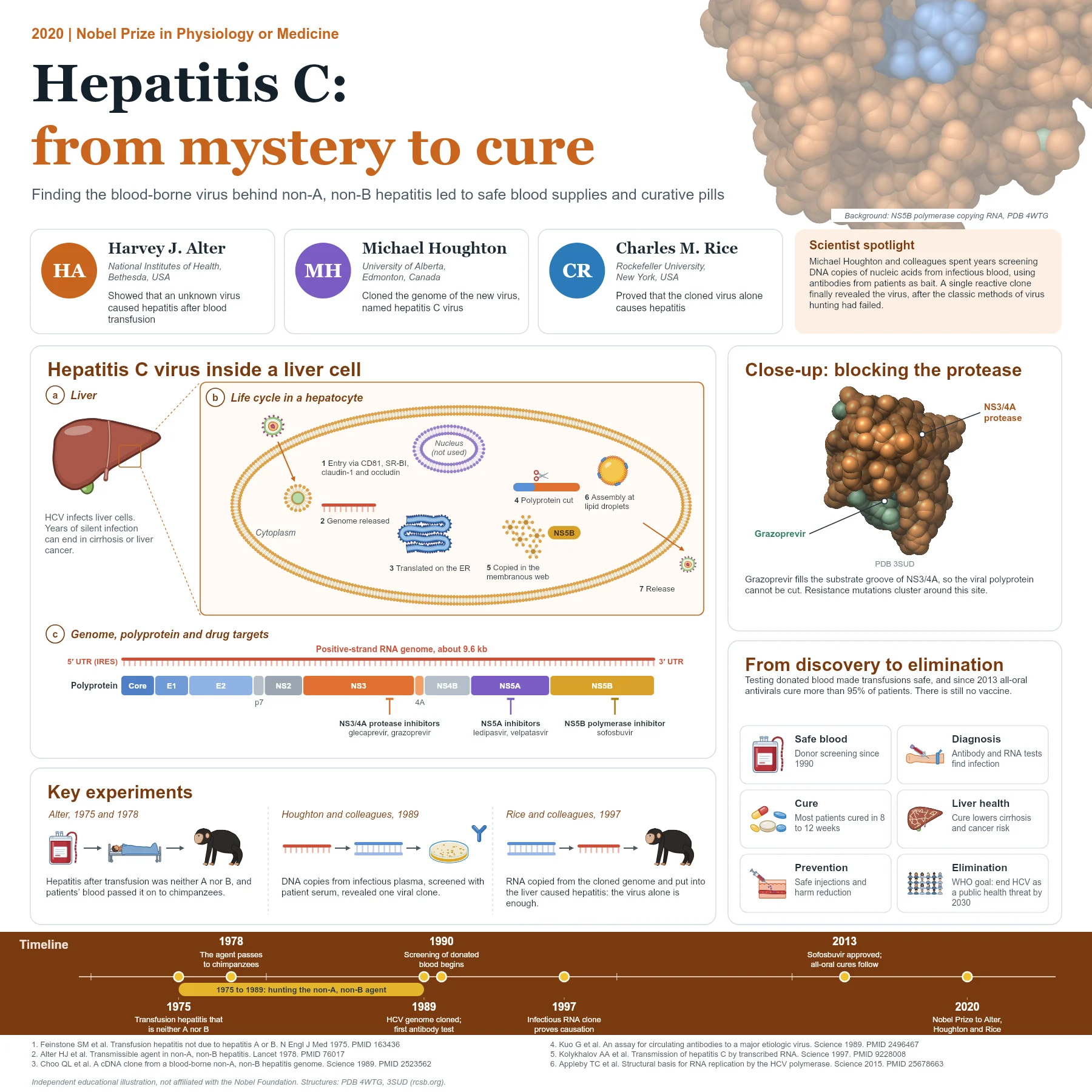
Yet patients kept developing hepatitis after blood transfusions. In 1975, Feinstone, Alter and colleagues at the National Institutes of Health reported that such cases showed no sign of infection with hepatitis A or B viruses. The disease was named non-A, non-B hepatitis. It was often silent for years but could lead to chronic liver disease, cirrhosis and liver cancer.
The discovery story: three decisive steps
Alter's group next asked whether the illness was infectious. In 1978 they inoculated chimpanzees with plasma or serum from patients with non-A, non-B hepatitis and from an implicated blood donor. The animals developed hepatitis, showing a transmissible agent that could persist in carriers. Over the following decade the agent resisted every classical method of virus hunting.
Michael Houghton and his colleagues took a molecular route. They made a library of DNA copies of nucleic acids from infectious plasma and screened it with serum from a patient with non-A, non-B hepatitis, looking for a clone that produced a protein recognised by the patient's antibodies. In 1989 they reported such a clone. It came from a positive-strand RNA molecule of about 10,000 nucleotides, consistent with a virus related to flaviviruses. The virus was named hepatitis C virus, and an antibody test followed in the same year.
One question remained: could the cloned virus alone cause hepatitis? Charles Rice and colleagues built full-length complementary DNA clones that defined the structure of a functional HCV genome. In 1997 they showed that RNA transcribed from such a clone and injected into the liver of chimpanzees produced viraemia and hepatitis. This proved that HCV by itself is sufficient to cause disease.
How hepatitis C virus works inside a liver cell
HCV is an enveloped virus that infects hepatocytes. It enters after attaching to a set of host factors that include CD81, scavenger receptor class B type I, claudin-1 and occludin, and is taken up by endocytosis. In the acidic endosome the viral envelope fuses with the host membrane and the positive-strand RNA genome is released into the cytoplasm.
The genome carries an internal ribosome entry site in its 5' untranslated region, which directs translation on the endoplasmic reticulum into a single polyprotein of about 3,000 amino acids. Host and viral proteases cut it into structural proteins (core, E1, E2) and non-structural proteins (p7, NS2, NS3, NS4A, NS4B, NS5A and NS5B). The NS3/4A protease makes most of the cuts. The replication proteins then remodel ER membranes into a membranous web, where the NS5B polymerase copies the genome through a negative-strand intermediate. New virions assemble near lipid droplets and leave the cell along the secretory pathway as lipid-rich particles. The virus never enters the nucleus.
From discovery to cure
Cloning the virus made diagnosis possible. Screening donated blood for HCV antibodies began around 1990 and, with later nucleic acid tests, made transfusion-transmitted hepatitis C rare in many countries. Knowing the genome also allowed scientists to study each viral enzyme, solve their structures and grow the virus in the laboratory.
Drug developers targeted three viral proteins: the NS3/4A protease (inhibitors such as glecaprevir and grazoprevir), NS5A (ledipasvir, velpatasvir and others) and the NS5B polymerase (the nucleotide analogue sofosbuvir, approved in 2013). Combinations of these direct-acting antivirals, taken as tablets for 8 to 12 weeks, cure more than 95% of patients. Cure lowers the risk of cirrhosis and liver cancer. There is still no vaccine.
Why it matters today
Hepatitis C is one of the few chronic viral infections that can be cured, and the World Health Organization has set the goal of eliminating viral hepatitis as a public health threat by 2030. The remaining challenge is finding and treating the many people who do not know they are infected. The discovery also shows the power of combining careful clinical observation, animal transmission studies and molecular cloning to identify a pathogen that could not be grown or seen.
Each laureate's step answered a different kind of question. Alter's work was clinical and epidemiological: it showed that a hidden agent existed and that it could be transmitted. Houghton's was molecular: it found the agent without ever seeing it, by letting patients' antibodies point to the right clone. Rice's was genetic: it closed the case by showing that the cloned genome alone is enough to cause disease, a modern version of Koch's postulates. Together they turned an anonymous diagnosis into a virus that can be tested for, studied in detail and cured.
Key takeaways
- Alter showed that transfusion hepatitis not caused by hepatitis A or B was due to a transmissible agent.
- Houghton and colleagues cloned the genome of hepatitis C virus in 1989 by screening a cDNA library with patient serum.
- Rice and colleagues proved in 1997 that RNA from a cloned HCV genome alone causes hepatitis in chimpanzees.
- HCV replicates entirely in the cytoplasm of hepatocytes; NS3/4A, NS5A and NS5B are drug targets.
- Direct-acting antivirals now cure more than 95% of patients.
References
- Feinstone SM, Kapikian AZ, Purcell RH, Alter HJ, Holland PV. Transfusion-associated hepatitis not due to viral hepatitis type A or B. N Engl J Med. 1975;292(15):767-70. PubMed 163436
- Alter HJ, Purcell RH, Holland PV, Popper H. Transmissible agent in non-A, non-B hepatitis. Lancet. 1978;1(8062):459-63. PubMed 76017
- Choo QL, Kuo G, Weiner AJ, Overby LR, Bradley DW, Houghton M. Isolation of a cDNA clone derived from a blood-borne non-A, non-B viral hepatitis genome. Science. 1989;244(4902):359-62. PubMed 2523562
- Kuo G, Choo QL, Alter HJ, et al. An assay for circulating antibodies to a major etiologic virus of human non-A, non-B hepatitis. Science. 1989;244(4902):362-4. PubMed 2496467
- Kolykhalov AA, Agapov EV, Blight KJ, Mihalik K, Feinstone SM, Rice CM. Transmission of hepatitis C by intrahepatic inoculation with transcribed RNA. Science. 1997;277(5325):570-4. PubMed 9228008
- Romano KP, Ali A, Aydin C, et al. The molecular basis of drug resistance against hepatitis C virus NS3/4A protease inhibitors. PLoS Pathog. 2012;8(7):e1002832. PubMed 22910833
- Appleby TC, Perry JK, Murakami E, et al. Structural basis for RNA replication by the hepatitis C virus polymerase. Science. 2015;347(6223):771-5. PubMed 25678663
An independent educational article and illustration by BioGein, not affiliated with or endorsed by the Nobel Foundation. Protein structures are rendered from Protein Data Bank entries (rcsb.org).