The question: how do bacteria fight viruses they have met before?
Bacteria live under constant attack from viruses called bacteriophages, or phages. For decades, microbiologists knew of defences such as restriction enzymes, which cut any foreign DNA carrying a particular short sequence. But some bacteria seemed able to do something more remarkable: to remember a specific virus and resist it the next time.
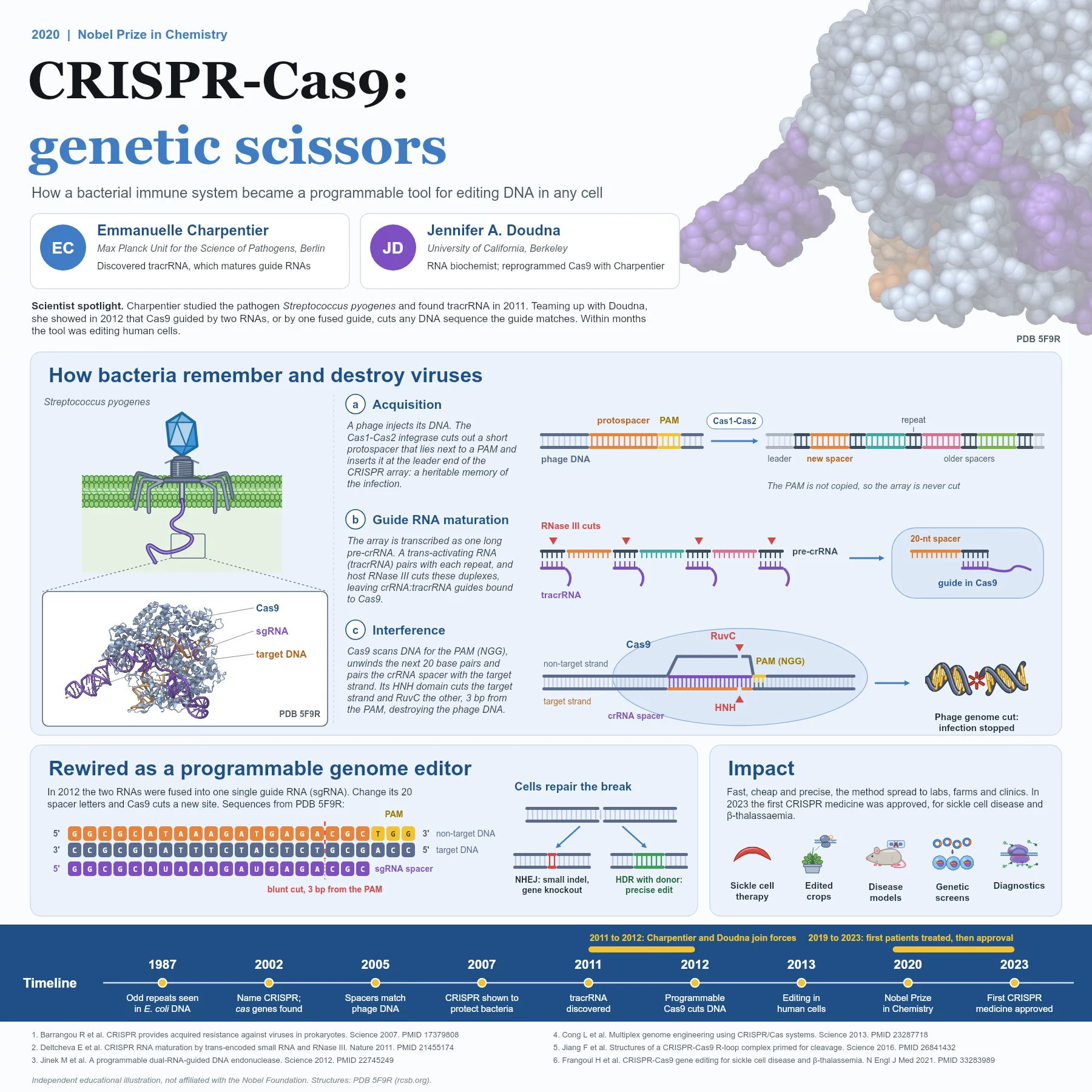
The clue sat in odd stretches of bacterial DNA. In 1987 researchers noticed short repeated sequences in the genome of Escherichia coli, separated by unique pieces of DNA. In 2002 these arrays were named CRISPR (clustered regularly interspaced short palindromic repeats), and a set of CRISPR-associated (cas) genes was found next to them. In 2005 several groups showed that the unique spacers match the DNA of phages and plasmids, which suggested a memory of past infections. In 2007 experiments in Streptococcus thermophilus proved it: bacteria that gained a new spacer from a phage became resistant to that phage.
The discovery story
Emmanuelle Charpentier studied Streptococcus pyogenes, a bacterium that causes human infections. In 2011 her team reported a previously unknown small RNA, the trans-activating CRISPR RNA or tracrRNA. They showed that tracrRNA pairs with the repeats of the long CRISPR transcript and that the host enzyme RNase III cuts these duplexes, producing the mature guide RNAs. Cas9 was needed for this step.
Charpentier then teamed up with Jennifer Doudna, a biochemist who studies RNA molecules and their structures. In a 2012 paper the two groups purified Cas9 and showed that, loaded with a crRNA and a tracrRNA, it cuts double-stranded DNA at the site that matches the guide, provided that a short motif called the PAM sits next to it. They also fused the two RNAs into one single guide RNA and showed that Cas9 could be reprogrammed by simply changing the guide sequence. Within months, other laboratories used the system to edit genes in human and mouse cells.
How the mechanism works
Bacterial immunity with CRISPR-Cas9 runs in three stages. In acquisition, the Cas1-Cas2 integrase takes a short protospacer from invading DNA, chosen next to a PAM, and inserts it as a new spacer at the leader end of the CRISPR array. The PAM itself is not copied, which is why the cell never attacks its own array.
In expression and maturation, the array is transcribed into one long precursor, the pre-crRNA. The tracrRNA pairs with each repeat, RNase III cuts the double-stranded regions, and each crRNA:tracrRNA guide is held by Cas9.
In interference, Cas9 scans DNA for the PAM, which for the Streptococcus pyogenes enzyme is NGG. When it finds one, it unwinds the neighbouring DNA and tests whether the 20-nucleotide spacer of its guide pairs with the target strand. If it does, two nuclease domains cut: HNH cuts the target strand and RuvC cuts the other strand, both three base pairs from the PAM, leaving a blunt double-strand break. Crystal structures such as the Cas9 complex with guide RNA and target DNA in PDB entry 5F9R show this R-loop state, poised for cleavage.
From discovery to applications
In a plant or animal cell, a double-strand break made by Cas9 must be repaired. Non-homologous end joining often adds or removes a few base pairs at the cut, which can disrupt the reading frame and knock out the gene. If the cell is given a donor DNA with sequences that match both sides of the cut, homology-directed repair can copy a precise change into the genome.
Because only the guide must be changed, CRISPR-Cas9 made gene editing fast and inexpensive. It is used to create disease models, to switch off every gene in turn in genetic screens, and to breed crops. Related CRISPR enzymes power sensitive diagnostic tests. In medicine, patients with sickle cell disease and transfusion-dependent beta-thalassaemia were treated with edited blood stem cells in a clinical study reported in 2021, and the first CRISPR-based therapy was approved in 2023.
Why it matters today
The CRISPR story shows how curiosity about a basic question, how bacteria fight viruses, can produce a tool that changes biology. It also raises questions that society continues to debate, from off-target edits and fair access to treatments to limits on editing the human germline. For students, the lesson is that a careful study of a bacterium's RNA biology became a technology used in nearly every life science laboratory.
The prize also highlights how fundamental research is often shared. Many groups contributed key steps, from the first description of the repeats to the proof of immunity and the first edits in human cells, and the field remains highly collaborative and competitive.
Key takeaways
- CRISPR arrays store pieces of past invaders as spacers, giving bacteria an adaptive immune memory.
- tracrRNA pairs with CRISPR repeats; RNase III and Cas9 then produce mature crRNA:tracrRNA guides.
- Cas9 needs a PAM (NGG) and a matching 20-nucleotide guide; HNH and RuvC cut the two strands three base pairs from the PAM.
- Fusing the two RNAs into one single guide RNA made Cas9 easy to reprogram.
- Repair of the break by end joining knocks genes out, while homology-directed repair from a donor makes precise edits.
References
- Jansen R, Embden JD, Gaastra W, et al. Identification of genes that are associated with DNA repeats in prokaryotes. Mol Microbiol. 2002;43(6):1565-75. PubMed 11952905
- Mojica FJ, Díez-Villaseñor C, García-Martínez J, et al. Intervening sequences of regularly spaced prokaryotic repeats derive from foreign genetic elements. J Mol Evol. 2005;60(2):174-82. PubMed 15791728
- Barrangou R, Fremaux C, Deveau H, et al. CRISPR provides acquired resistance against viruses in prokaryotes. Science. 2007;315(5819):1709-12. PubMed 17379808
- Deltcheva E, Chylinski K, Sharma CM, et al. CRISPR RNA maturation by trans-encoded small RNA and host factor RNase III. Nature. 2011;471(7340):602-7. PubMed 21455174
- Jinek M, Chylinski K, Fonfara I, et al. A programmable dual-RNA-guided DNA endonuclease in adaptive bacterial immunity. Science. 2012;337(6096):816-21. PubMed 22745249
- Cong L, Ran FA, Cox D, et al. Multiplex genome engineering using CRISPR/Cas systems. Science. 2013;339(6121):819-23. PubMed 23287718
- Jiang F, Taylor DW, Chen JS, et al. Structures of a CRISPR-Cas9 R-loop complex primed for DNA cleavage. Science. 2016;351(6275):867-71. PubMed 26841432
- Frangoul H, Altshuler D, Cappellini MD, et al. CRISPR-Cas9 Gene Editing for Sickle Cell Disease and β-Thalassemia. N Engl J Med. 2021;384(3):252-260. PubMed 33283989
An independent educational article and illustration by BioGein, not affiliated with or endorsed by the Nobel Foundation. Protein structures are rendered from Protein Data Bank entries (rcsb.org).