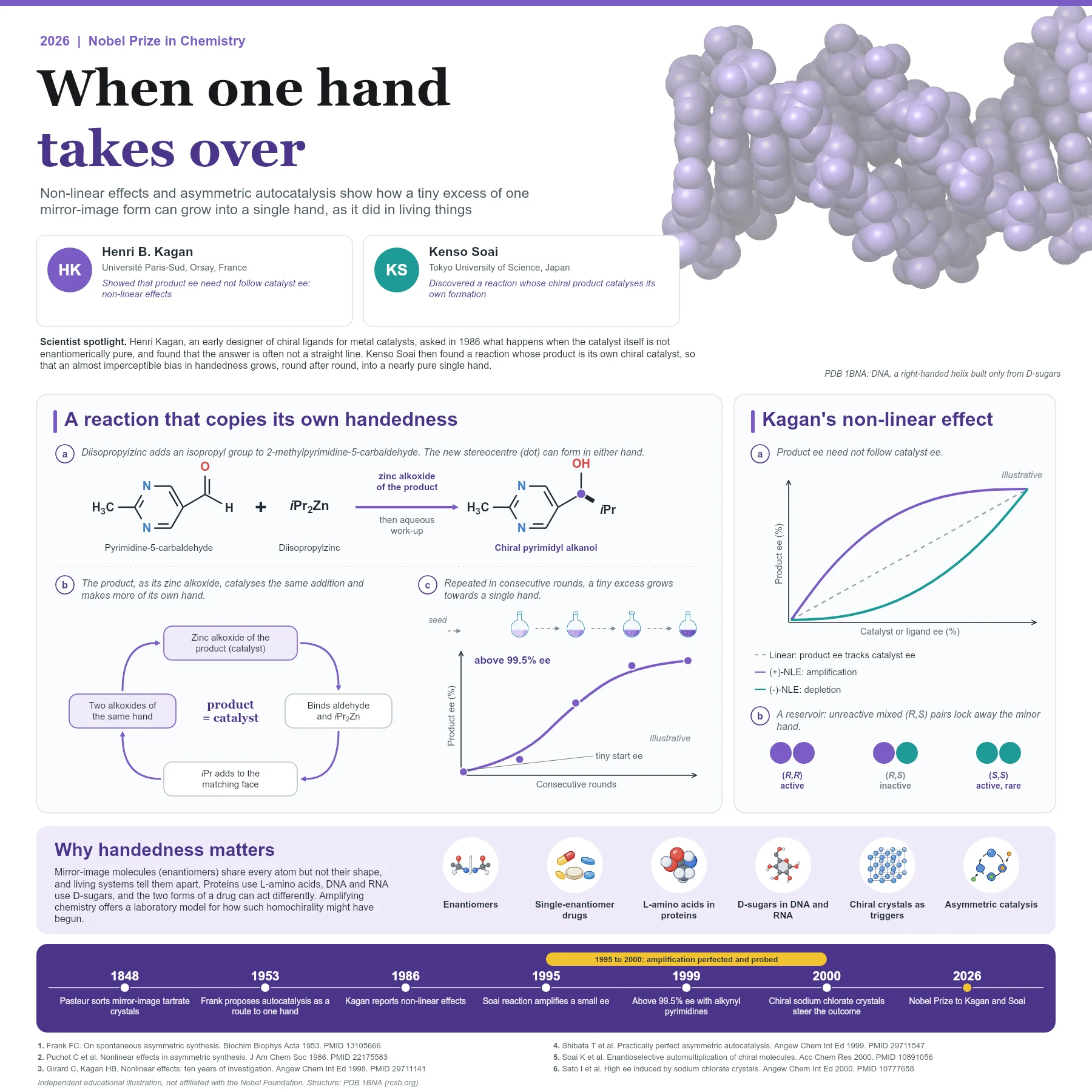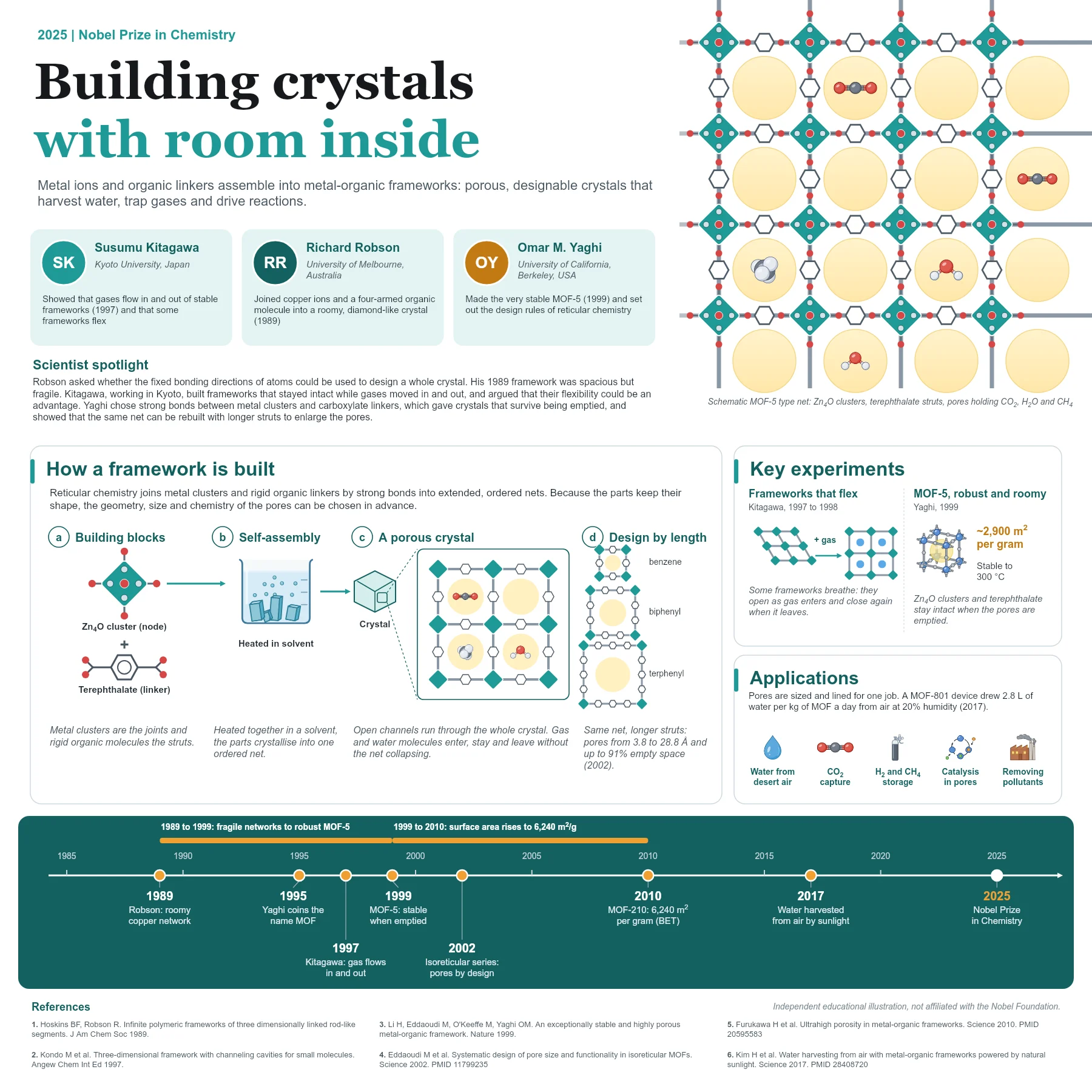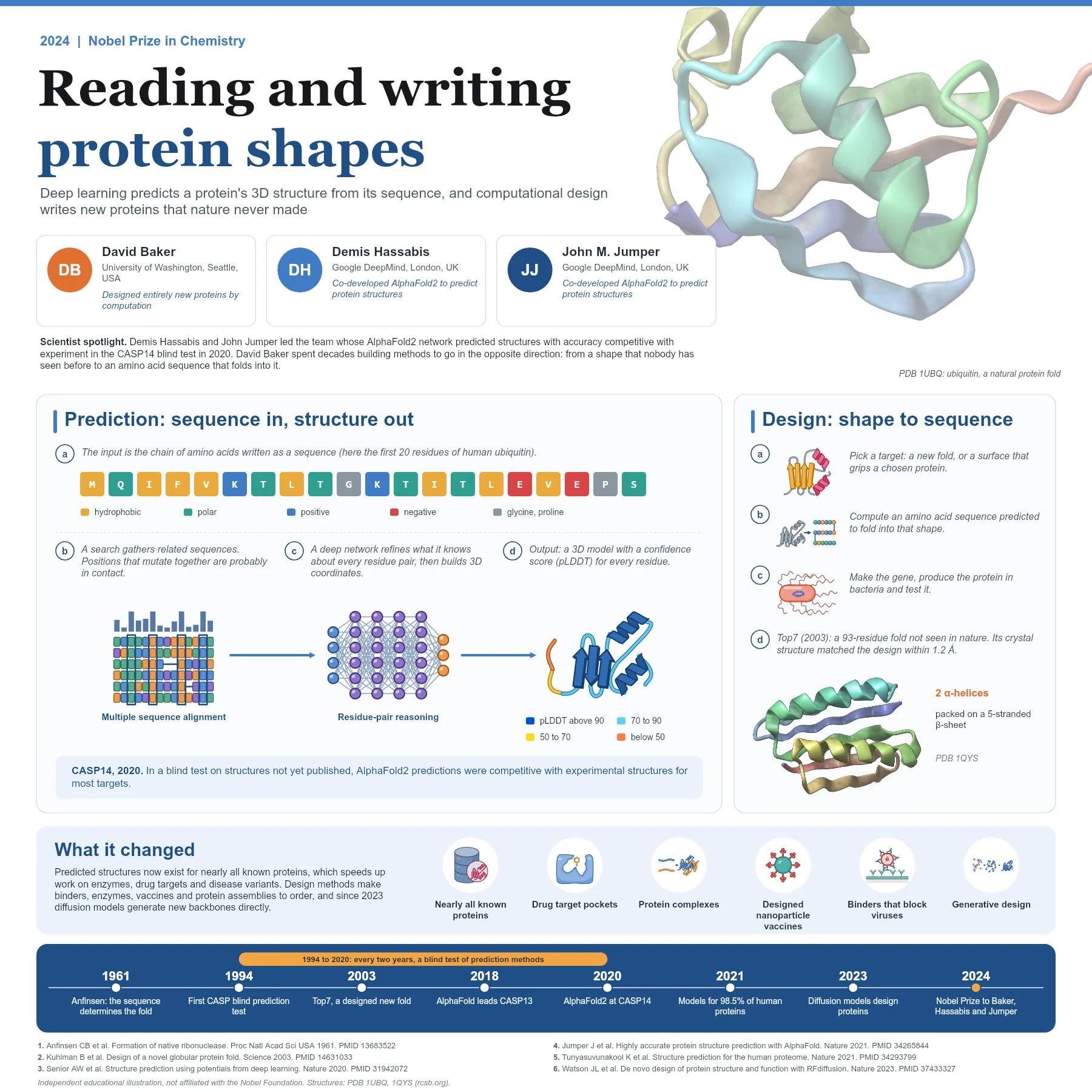
The question: how do you store a lot of energy in a small, light package?
Lithium is the lightest metal and gives up its electron very readily, which makes it ideal for storing electrical energy. The same eagerness makes lithium metal dangerous: it reacts with water and air, and in early rechargeable cells it could grow needle-like deposits that short-circuited the battery.
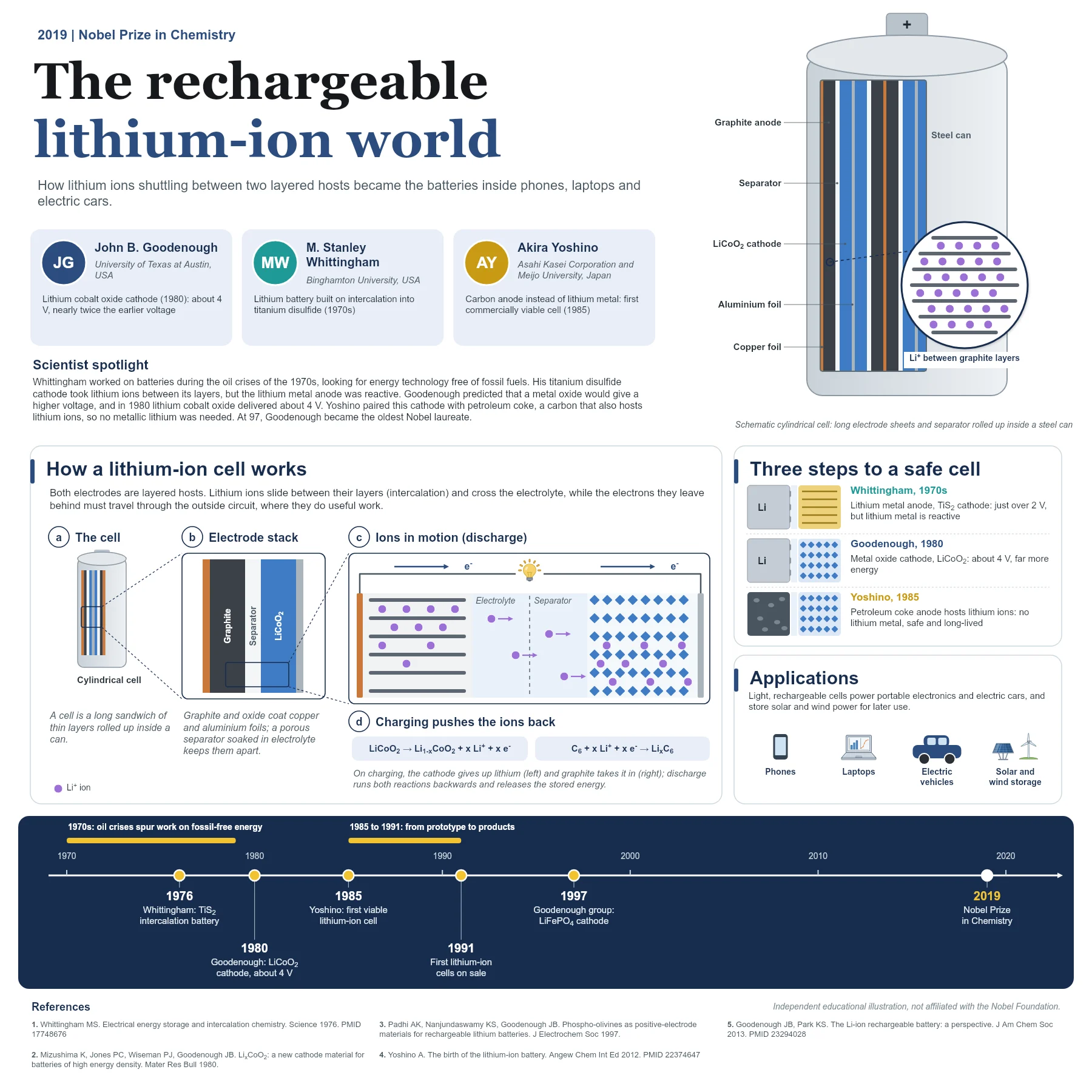
The 2019 Nobel Prize in Chemistry was awarded to John B. Goodenough, M. Stanley Whittingham and Akira Yoshino for the development of lithium-ion batteries, which solved this problem by never letting the lithium exist as a metal at all.
The discovery story
During the oil crises of the 1970s, Whittingham worked on energy technologies that could reduce dependence on fossil fuels. He found that titanium disulfide, a layered material, could take lithium ions in between its layers and release them again, a process called intercalation. In 1976 he described a battery with a titanium disulfide cathode and a lithium metal anode. It gave just over two volts and worked at room temperature, but the metallic lithium anode made it reactive and hard to make safe.
Goodenough reasoned that a metal oxide, rather than a sulfide, would hold lithium at a higher voltage. In 1980, at the University of Oxford, he and his colleagues showed that lithium cobalt oxide, another layered material, delivered about four volts, nearly twice as much. This made a far more powerful battery possible.
Yoshino, working in industrial research in Japan, then replaced the lithium metal anode. In 1985 he built a cell in which the anode was petroleum coke, a carbon material that can also take lithium ions between its layers, paired with Goodenough's lithium cobalt oxide cathode. Because the cell is assembled with all the lithium inside the oxide, no metallic lithium is needed. The result was light, durable, could be recharged hundreds of times, and was the first commercially viable lithium-ion battery. The first lithium-ion cells went on sale in 1991.
How a lithium-ion cell works
A cell contains two electrodes coated on thin metal foils: a carbon anode, today usually graphite, on copper, and an oxide cathode on aluminium. A porous separator soaked in an organic electrolyte containing a lithium salt keeps the electrodes apart while letting ions pass. In a cylindrical cell these layers are long sheets rolled up inside a steel can.
When the battery is charged, an external source pulls lithium ions out of the oxide and pushes them through the electrolyte into the graphite, where they slip between the carbon layers. The electrons make the same trip through the outside circuit. On discharge the process runs backwards: lithium ions leave the graphite, cross the electrolyte and slide back into the oxide, while the electrons travel through the device being powered. Neither electrode is consumed; both are hosts that lithium ions visit and leave. This rocking motion is why the cell can be charged and discharged so many times.
The voltage of the cell comes from the difference in how strongly the two hosts hold lithium. Lithium sits at a high energy in graphite and at a much lower energy in the cobalt oxide, so moving it from one to the other releases energy. Goodenough's insight was that oxygen ions bind the metal's electrons more tightly than sulfur does, which lowers the energy of lithium in an oxide and raises the cell voltage from about two to about four volts. Higher voltage means more energy stored in each gram, which is what made small, light batteries possible.
From discovery to applications
Lithium-ion batteries made mobile phones and laptops practical and now power electric vehicles, from cars to buses. Because they can store electricity from solar panels and wind turbines, they also help balance grids that rely on renewable power.
The chemistry continues to evolve. In 1997 Goodenough's group introduced lithium iron phosphate, a cheaper and more thermally stable cathode now widely used, and researchers keep improving energy density, safety and the sourcing of materials such as cobalt.
Why it matters today
The lithium-ion battery is a story of materials chemistry: finding hosts with open layers, choosing the right voltage, and removing the most dangerous component. It has reshaped daily life and is central to moving away from fossil fuels. At 97, Goodenough also became the oldest person to receive a Nobel Prize.
The three steps also show how science builds on itself. Whittingham supplied the idea of a host that lithium ions can enter and leave; Goodenough found a host with a much higher voltage; Yoshino removed the hazardous metal by giving lithium a second host on the other side. None of the three advances alone would have produced the battery that is now in billions of devices.
Key takeaways
- A lithium-ion cell stores energy by moving lithium ions between two layered host materials (intercalation).
- Whittingham built a titanium disulfide battery in the 1970s; Goodenough's lithium cobalt oxide raised the voltage to about 4 V in 1980.
- Yoshino's carbon anode removed metallic lithium and gave the first commercially viable cell in 1985; products followed in 1991.
- These batteries power portable electronics and electric vehicles and store renewable electricity.
References
- Whittingham MS. Electrical energy storage and intercalation chemistry. Science. 1976;192(4244):1126-1127. PubMed 17748676
- Mizushima K, Jones PC, Wiseman PJ, Goodenough JB. LixCoO2 (0<x≤1): a new cathode material for batteries of high energy density. Mater Res Bull. 1980;15:783-789. DOI
- Padhi AK, Nanjundaswamy KS, Goodenough JB. Phospho-olivines as positive-electrode materials for rechargeable lithium batteries. J Electrochem Soc. 1997;144:1188-1194. DOI
- Yoshino A. The birth of the lithium-ion battery. Angew Chem Int Ed Engl. 2012;51(24):5798-5800. PubMed 22374647
- Goodenough JB, Park KS. The Li-ion rechargeable battery: a perspective. J Am Chem Soc. 2013;135(4):1167-1176. PubMed 23294028
An independent educational article and illustration by BioGein, not affiliated with or endorsed by the Nobel Foundation. Protein structures are rendered from Protein Data Bank entries (rcsb.org).