The question: what keeps time inside us?
Plants, animals and many microbes anticipate the daily cycle of light and dark. Sleep, body temperature, hormone release and metabolism rise and fall on a roughly 24-hour schedule that continues even in constant darkness. This internal timekeeper is the circadian clock, from the Latin circa diem, "about a day".
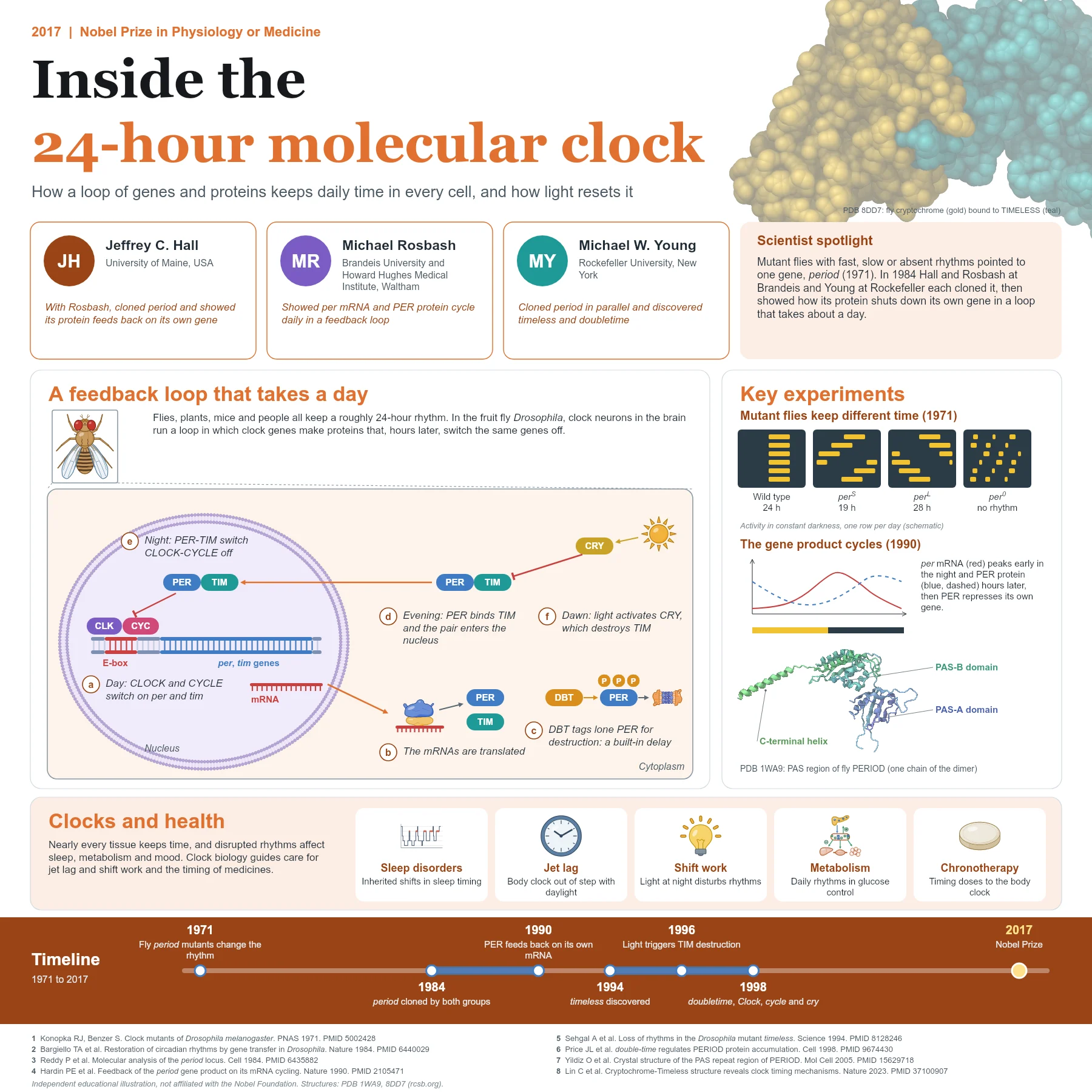
By the 1970s it was clear that the clock was inherited, but its molecular nature was a mystery. The decisive clues came from the fruit fly Drosophila melanogaster. Flies were well suited because two rhythms are easy to measure: the time of day at which adults emerge from the pupal case and the daily pattern of walking activity of individual flies.
The discovery story
In 1971 a genetic screen identified flies whose rhythms ran fast (about 19 hours), slow (about 28 hours) or not at all. All three mutations mapped to the same gene, which was named period. In 1984 Jeffrey Hall and Michael Rosbash at Brandeis University, and independently Michael Young at Rockefeller University, isolated the period gene; Young’s group showed that adding the gene back to arrhythmic flies restored their rhythms.
Hall and Rosbash then found that period mRNA and its protein, PER, rise and fall over the day, and in 1990 proposed that PER feeds back to repress its own gene. How PER, made in the cytoplasm, reached the nucleus was explained when Young discovered a second clock gene, timeless, in 1994: its protein TIM binds PER and the pair enter the nucleus together. In 1998 Young’s group identified doubletime, which encodes a kinase that phosphorylates PER and controls its stability. In the same year, studies from the Hall and Rosbash laboratories and their collaborators identified the activators CLOCK and CYCLE and the light-sensitive protein cryptochrome, completing the core picture.
How the mechanism works
During the day, the transcription factors CLOCK and CYCLE bind E-box sequences and switch on the period and timeless genes. The mRNAs are exported and translated in the cytoplasm. On its own, PER is phosphorylated by DOUBLETIME and degraded, which delays its build-up; as TIM accumulates, it binds and stabilises PER.
In the evening, PER and TIM enter the nucleus and block CLOCK and CYCLE, so transcription of their own genes falls. Over the night PER and TIM are gradually removed, repression lifts and a new cycle begins. The built-in delays, from transcription, translation, phosphorylation and nuclear entry, make one turn of the loop take about 24 hours.
Light keeps the clock in step with the outside world. In flies, light activates cryptochrome, which binds TIM and triggers its destruction, resetting the phase each morning. A recent cryo-electron microscopy structure of fly cryptochrome bound to TIMELESS (PDB 8DD7) shows this interaction in molecular detail, and the crystal structure of the PER PAS domains (PDB 1WA9) shows how PER forms dimers.
From discovery to applications
The same design, with related genes, runs clocks in mammals. CLOCK and BMAL1 play the roles of fly CLOCK and CYCLE, the PERIOD and CRYPTOCHROME proteins act as repressors, and casein kinase 1 delta and epsilon, relatives of DOUBLETIME, phosphorylate PER. A master clock in the suprachiasmatic nucleus of the hypothalamus receives light information directly from the retina and coordinates clocks in almost every tissue.
In humans, a mutation in PER2 that alters its phosphorylation causes familial advanced sleep phase syndrome, in which people fall asleep and wake several hours early. Mutations in human clock genes can shift sleep timing, and misalignment between the internal clock and daily life, as in jet lag and shift work, is linked to poor sleep and metabolic problems. Chronotherapy, timing medicines to the body clock, aims to improve the balance between benefit and side effects.
Why it matters today
The circadian clock is a textbook example of a transcriptional feedback loop, and it shows how a behaviour can be traced to molecules. Starting from flies that woke at the wrong time, the laureates uncovered a mechanism that touches sleep medicine, metabolism and pharmacology.
Clock research has also changed how experiments are designed. Many physiological measurements and drug responses depend on the time of day, so studies increasingly record and control circadian time, both in the laboratory and in the clinic.
Key takeaways
- Mutations in one fly gene, period, made rhythms faster, slower or absent.
- PER and TIM proteins accumulate, enter the nucleus and repress their own genes.
- DOUBLETIME phosphorylates PER, adding a delay that sets the 24-hour period.
- Light acts through cryptochrome to destroy TIM and reset the clock each day.
References
- Konopka RJ, Benzer S. Clock mutants of Drosophila melanogaster. Proc Natl Acad Sci U S A. 1971;68(9):2112-6. PubMed 5002428
- Bargiello TA, Jackson FR, Young MW. Restoration of circadian behavioural rhythms by gene transfer in Drosophila. Nature. 1984;312(5996):752-4. PubMed 6440029
- Reddy P, Zehring WA, Wheeler DA, et al. Molecular analysis of the period locus in Drosophila melanogaster and identification of a transcript involved in biological rhythms. Cell. 1984;38(3):701-10. PubMed 6435882
- Hardin PE, Hall JC, Rosbash M. Feedback of the Drosophila period gene product on circadian cycling of its messenger RNA levels. Nature. 1990;343(6258):536-40. PubMed 2105471
- Sehgal A, Price JL, Man B, et al. Loss of circadian behavioral rhythms and per RNA oscillations in the Drosophila mutant timeless. Science. 1994;263(5153):1603-6. PubMed 8128246
- Myers MP, Wager-Smith K, Rothenfluh-Hilfiker A, et al. Light-induced degradation of TIMELESS and entrainment of the Drosophila circadian clock. Science. 1996;271(5256):1736-40. PubMed 8596937
- Price JL, Blau J, Rothenfluh A, et al. double-time is a novel Drosophila clock gene that regulates PERIOD protein accumulation. Cell. 1998;94(1):83-95. PubMed 9674430
- Yildiz O, Doi M, Yujnovsky I, et al. Crystal structure and interactions of the PAS repeat region of the Drosophila clock protein PERIOD. Mol Cell. 2005;17(1):69-82. PubMed 15629718
- Lin C, Feng S, DeOliveira CC, et al. Cryptochrome-Timeless structure reveals circadian clock timing mechanisms. Nature. 2023;617(7959):194-199. PubMed 37100907
An independent educational article and illustration by BioGein, not affiliated with or endorsed by the Nobel Foundation. Protein structures are rendered from Protein Data Bank entries (rcsb.org).