The question: how to treat diseases of the world's poorest people
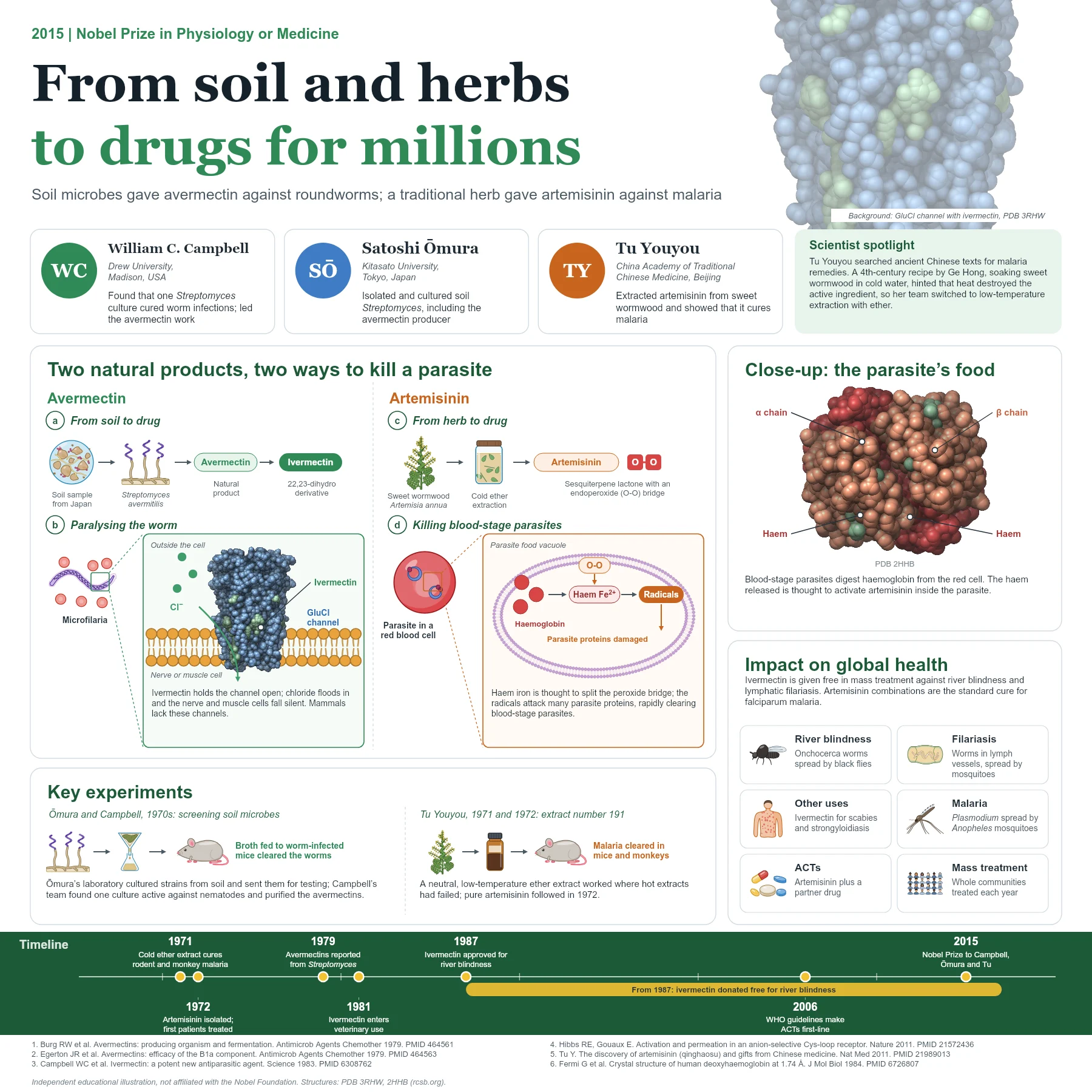
Parasitic diseases have long hit hardest in tropical regions with the fewest resources. River blindness (onchocerciasis) is caused by the roundworm Onchocerca volvulus, spread by black flies that breed in fast-flowing rivers; its larvae, called microfilariae, migrate through the skin and eyes and can cause blindness. Lymphatic filariasis, caused by worms such as Wuchereria bancrofti and spread by mosquitoes, damages lymph vessels and can lead to severe swelling of the limbs.
Malaria, caused by Plasmodium parasites and transmitted by Anopheles mosquitoes, killed vast numbers of people every year. By the 1960s the parasite was becoming resistant to chloroquine, the mainstay of treatment, and new drugs were urgently needed. The 2015 prize was shared between two discoveries that answered these needs: half to William Campbell and Satoshi Ōmura, half to Tu Youyou.
Avermectin: a drug from a soil microbe
Satoshi Ōmura, a microbiologist at the Kitasato Institute in Tokyo, specialised in isolating Streptomyces bacteria from soil and growing them in culture, because these microbes are rich sources of bioactive natural products. He selected promising strains and sent them for testing to a research laboratory in the United States where William Campbell, a parasitologist, led the screening for antiparasitic activity.
Campbell's team found that one culture, from a strain later named Streptomyces avermitilis, cleared nematode worms when fed to infected mice. The active components, a family of macrocyclic lactones, were purified and named avermectins; the producing organism, fermentation and anthelmintic efficacy were reported in 1979. A chemically modified form, 22,23-dihydroavermectin B1, called ivermectin, proved even more effective and safer. Ivermectin entered veterinary use in 1981 and was approved for human onchocerciasis in 1987.
How the two drugs kill parasites
Ivermectin targets glutamate-gated chloride channels, which are found in nerve and muscle cells of invertebrates such as nematodes and insects but not in mammals. The crystal structure of a nematode channel solved in 2011 shows ivermectin wedged between subunits in the membrane-spanning region, holding the channel open. Chloride ions then flow into the cells, the membrane is hyperpolarised and the worm's nerves and muscles fall silent. Paralysed microfilariae are cleared from the skin and eyes. In mammals, the blood-brain barrier pump P-glycoprotein largely keeps ivermectin out of the brain.
Artemisinin works very differently. It is a sesquiterpene lactone carrying an unusual endoperoxide bridge. Blood-stage malaria parasites live inside red blood cells and digest haemoglobin in their food vacuole, releasing haem. Haem iron is thought to split the peroxide bridge, producing reactive radicals that damage many parasite proteins. Artemisinins clear parasites from the blood faster than any other antimalarial.
Artemisinin: a clue from an ancient text
In 1969 Tu Youyou joined a national research programme in China to find new malaria treatments. Her team surveyed traditional remedies and tested extracts in mice infected with malaria. An extract of sweet wormwood, Artemisia annua, showed promising but inconsistent activity. Tu returned to the literature and found a recipe from the 4th-century physician Ge Hong that soaked the herb in cold water and wrung out the juice. This suggested that heat might destroy the active ingredient.
Switching to low-temperature extraction with ether, her team obtained in 1971 a neutral extract, number 191, that completely inhibited malaria parasites in mice and monkeys. In 1972 they purified the active compound, later named artemisinin, and the first clinical tests in patients followed. Artemisinin derivatives, combined with longer-acting partner drugs as artemisinin-based combination therapies, became the WHO-recommended first-line treatment for falciparum malaria.
Why it matters today
Since 1987 ivermectin has been donated free for river blindness, and later for lymphatic filariasis, in programmes that treat whole communities each year. Transmission of river blindness has been eliminated in several foci, and ivermectin is also used against strongyloidiasis and scabies. Artemisinin combination therapies have contributed to a large fall in malaria deaths since 2000, although partial resistance to artemisinin in some regions now demands careful stewardship and new drugs. Both stories show how natural products, from soil microbes to traditional medicinal plants, remain a rich source of medicines when combined with careful pharmacology.
The two halves of the prize also illustrate two different routes to discovery. The avermectin story is one of systematic screening: thousands of microbial cultures, a well-designed animal test and medicinal chemistry that turned a natural product into a safer derivative. The artemisinin story began with a reading of historical texts and a practical insight about extraction temperature, followed by the same careful testing in animals and patients. In both cases, the decisive step was a laboratory experiment that showed a clear effect on the parasite, and both drugs were then developed into treatments that reached the communities most in need.
Key takeaways
- Ōmura cultured soil Streptomyces strains; Campbell's team found that one produced avermectins, potent against parasitic worms.
- Ivermectin opens glutamate-gated chloride channels in worm nerves and muscles, causing paralysis.
- Tu Youyou used low-temperature ether extraction of sweet wormwood to obtain artemisinin, isolated in 1972.
- Artemisinin's endoperoxide bridge is thought to be activated by haem iron, killing blood-stage malaria parasites.
- Mass ivermectin donation and artemisinin combination therapy have treated hundreds of millions of people.
References
- Burg RW, Miller BM, Baker EE, et al. Avermectins, new family of potent anthelmintic agents: producing organism and fermentation. Antimicrob Agents Chemother. 1979;15(3):361-7. PubMed 464561
- Egerton JR, Ostlind DA, Blair LS, et al. Avermectins, new family of potent anthelmintic agents: efficacy of the B1a component. Antimicrob Agents Chemother. 1979;15(3):372-8. PubMed 464563
- Campbell WC, Fisher MH, Stapley EO, et al. Ivermectin: a potent new antiparasitic agent. Science. 1983;221(4613):823-8. PubMed 6308762
- Hibbs RE, Gouaux E. Principles of activation and permeation in an anion-selective Cys-loop receptor. Nature. 2011;474(7349):54-60. PubMed 21572436
- Tu Y. The discovery of artemisinin (qinghaosu) and gifts from Chinese medicine. Nat Med. 2011;17(10):1217-20. PubMed 21989013
- Fermi G, Perutz MF, Shaanan B, Fourme R. The crystal structure of human deoxyhaemoglobin at 1.74 A resolution. J Mol Biol. 1984;175(2):159-74. PubMed 6726807
An independent educational article and illustration by BioGein, not affiliated with or endorsed by the Nobel Foundation. Protein structures are rendered from Protein Data Bank entries (rcsb.org).